Skip to main content
General Biology
My Course
Learn
Exam Prep
AI Tutor
Study Guides
Textbook Solutions
Flashcards
Explore
Try the app
My Course
Learn
Exam Prep
AI Tutor
Study Guides
Textbook Solutions
Flashcards
Explore
Try the app
Back
Signal Amplification exam
You can tap to flip the card.
Signal Amplification
You can tap to flip the card.
👆
Signal Amplification
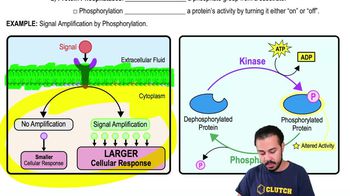
Occurs when a signaling molecule binds to its receptor, leading to a larger cellular response through the activation of multiple molecules.
Track progress
Control buttons has been changed to "navigation" mode.
1/28
Related flashcards
Related practice
Recommended videos
Signal Amplification definitions
Signal Amplification
11 Terms
Signal Amplification quiz #1
Signal Amplification
4 Terms
Signal Amplification quiz #1
Signal Amplification
10 Terms
Signal Amplification
10. Cell Signaling
6 problems
Topic
Jason
Types of Cell Signaling
10. Cell Signaling
3 problems
Topic
Jason
10. Cell Signaling
4 topics
9 problems
Chapter
Jason
02:35
Phosphorylation Cascades
7020
views
56
rank
06:10
Signal Amplification
7652
views
73
rank
Terms in this set (28)
Hide definitions
Signal Amplification
Occurs when a signaling molecule binds to its receptor, leading to a larger cellular response through the activation of multiple molecules.
What is the role of protein kinases in signal amplification?
Protein kinases add phosphate groups to proteins, which can activate or deactivate them, playing a crucial role in signal amplification.
Phosphorylation
The process of adding a phosphate group to a protein, altering its activity.
What happens when a signaling molecule binds to its receptor?
It can cause a conformational change in the receptor, leading to signal amplification or a smaller cellular response.
Protein Phosphatases
Enzymes that remove phosphate groups from proteins, often deactivating them.
What is a phosphorylation cascade?
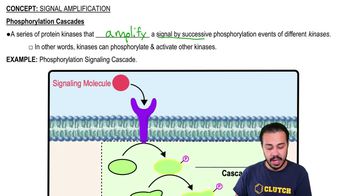
A series of protein kinases that amplify a signal by successive phosphorylation events of different kinases.
Conformational Change
A structural change in a receptor that occurs when a signaling molecule binds to it.
How do protein kinases and protein phosphatases differ?
Protein kinases add phosphate groups to proteins, while protein phosphatases remove them.
Cellular Response
The outcome or effect within a cell following signal amplification.
What is the source of the phosphate group in phosphorylation?
ATP, which gets hydrolyzed into ADP.
Dephosphorylated Protein
A protein that does not have a phosphate group attached.
What is the effect of phosphorylation on a protein?
It alters the protein's activity, either activating or deactivating it.
Phosphorylated Protein
A protein that has a phosphate group attached, often leading to altered activity.
What is the role of ATP in phosphorylation?
ATP provides the phosphate group that is added to proteins during phosphorylation.
Signal Molecule
A molecule that binds to a receptor to initiate signal amplification.
What happens in a phosphorylation signaling cascade?
A kinase enzyme becomes phosphorylated and activates other kinases in a series of successive phosphorylation events.
Extracellular Fluid
The fluid outside of a cell where signaling molecules are often found.
What is the function of protein phosphatases in signal amplification?
They remove phosphate groups from proteins, often deactivating them and dampening the cellular response.
Cytoplasm
The inside of the cell where signal amplification processes occur.
What is the result of signal amplification?
A larger cellular response due to the activation of many molecules.
Receptor
A protein embedded in the cell membrane that binds to signaling molecules.
How does signal amplification maximize cellular response?
By activating many molecules, leading to a larger and more effective cellular response.
Phosphorylation Events
Successive actions where kinases add phosphate groups to proteins, amplifying the signal.
What is the importance of understanding signal amplification?
It is crucial for grasping cellular communication and response dynamics in biological systems.
Kinase Enzyme
An enzyme that adds phosphate groups to proteins, playing a key role in phosphorylation cascades.
What does a conformational change in a receptor lead to?
It can lead to either signal amplification or a smaller cellular response.
Phosphate Group
A chemical group added to proteins by kinases, altering their activity.
What is the role of phosphorylation in signal amplification?
Phosphorylation alters protein activity, which can activate other proteins and amplify the signal.
 BackBack
 02:35
02:35