 Back
BackSoil and Nutrients quiz #1

 04:51
04:51
Terms in this set (32)
What is soil composed of?
Soil is composed of inorganic minerals, organic matter, trapped gases, liquids (mostly water), and many living organisms.
What is humus and why is it important?
Humus is decaying organic matter that enriches soil with nutrients, essential for plant growth.
How does soil texture affect plant growth?
Soil texture, which is the proportion of gravel, sand, and clay, affects plant roots' ability to penetrate and absorb nutrients, as well as the soil's capacity to hold water and oxygen.
What is loam and why is it considered high-quality soil?
Loam is a type of soil with equal proportions of sand, silt, and clay, enriched with lots of humus, making it highly fertile.
What is topsoil and why is it significant?
Topsoil is the outermost soil layer with the highest concentration of humus and microorganisms, crucial for plant growth.
What role do worms play in soil health?
Worms move soil around, cycle nutrients, and improve soil's ability to retain gases and water.
What are soil horizons?
Soil horizons are layers of soil that vary in color and composition, extending from the surface to the bedrock.
How does soil pH affect nutrient absorption?
Soil pH affects nutrient absorption by influencing the solubility of nutrients; acidic soils can lead to nutrient leaching, while alkaline soils can limit nutrient availability.
What is cation exchange in soil?
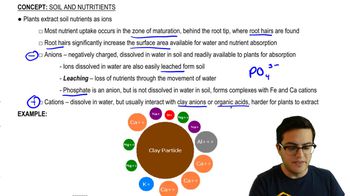
Cation exchange is the process where plants release protons to displace nutrient cations like magnesium and calcium from soil particles, making them available for absorption.
How do plants use proton pumps in nutrient absorption?
Plants use proton pumps to create electrochemical gradients, allowing ions to enter cells through transporters.
What is the role of root hairs in nutrient absorption?
Root hairs increase the surface area for water and nutrient absorption, significantly enhancing the plant's ability to take up nutrients.
What is nitrogen fixation and why is it important for plants?
Nitrogen fixation is the conversion of atmospheric nitrogen (N2) into ammonia (NH3) by bacteria and archaea, making nitrogen available for plant absorption.
What are the two main forms of nitrogen absorbed by plants?
Plants primarily absorb nitrogen in the forms of ammonium (NH4+) and nitrates (NO3-).
How do carnivorous plants obtain nitrogen?
Carnivorous plants obtain nitrogen by consuming animals, supplementing their nitrogen intake.
What is the significance of the nitrogen cycle in ecosystems?
The nitrogen cycle converts nitrogen into various chemical forms, making it available for plant and animal use, and is essential for ecosystem health.