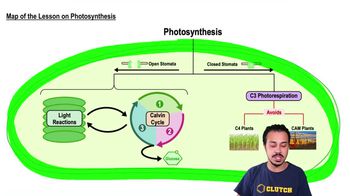
What are the two main stages of photosynthesis, where do they occur within the chloroplast, and what are their primary functions?
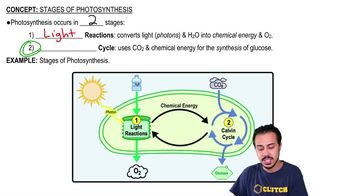
The two main stages of photosynthesis are the light reactions and the Calvin cycle. The light reactions occur in the thylakoids of the chloroplast and convert light energy and water into chemical energy (ATP and NADPH) and oxygen. The Calvin cycle takes place in the stroma and uses carbon dioxide and the chemical energy from the light reactions to synthesize glucose.
How do open and closed stomata affect the process of photosynthesis in plants?
Open stomata allow for gas exchange, enabling carbon dioxide to enter the leaf and oxygen to exit, which supports normal photosynthesis. Closed stomata prevent gas exchange, limiting carbon dioxide intake and oxygen release, which can lead to photorespiration and reduced photosynthetic efficiency.
What are the two main stages of photosynthesis and where do they occur within the chloroplast?
The two main stages are the light reactions, which occur in the thylakoids, and the Calvin cycle, which occurs in the stroma.
What are the primary functions of the light reactions in photosynthesis?
The light reactions convert light energy and water into chemical energy (ATP and NADPH) and produce oxygen gas.
What does the Calvin cycle use to synthesize glucose?
The Calvin cycle uses carbon dioxide from the atmosphere and the chemical energy produced by the light reactions to synthesize glucose.
What are the main inputs and outputs of the chloroplast during photosynthesis?
The main inputs are solar energy, water, and carbon dioxide; the outputs are oxygen gas and glucose.
How do open stomata affect the process of photosynthesis?
Open stomata allow for gas exchange, enabling carbon dioxide to enter the leaf and oxygen to exit, which supports normal photosynthesis.
What happens to photosynthesis when stomata are closed?
Closed stomata prevent gas exchange, limiting carbon dioxide intake and oxygen release, which can lead to photorespiration and reduced photosynthetic efficiency.
What is the role of the chloroplast in photosynthesis?
The chloroplast is the site where both the light reactions and the Calvin cycle of photosynthesis occur.
What is photorespiration and under what condition does it occur?
Photorespiration is a process that occurs when stomata are closed, preventing carbon dioxide from entering and leading to reduced photosynthetic efficiency.
What is one component in photosynthesis that is not recycled during the process?
Energy from sunlight is not recycled in photosynthesis; it is converted into chemical energy and used up during the process.
What is the first step in photosynthesis?
The first step in photosynthesis is the light reactions, which occur in the thylakoids of the chloroplast.
Which stage of photosynthesis occurs first?
The light reactions are the first stage of photosynthesis.
Which molecule is not a product of photosynthesis but is used in the Calvin cycle?
Carbon dioxide is not a product of photosynthesis; it is a reactant used in the Calvin cycle.
What are the two main stages of photosynthesis?
The two main stages of photosynthesis are the light reactions and the Calvin cycle.
What is stage one of photosynthesis and where does it occur?
Stage one of photosynthesis is the light reactions, which occur in the thylakoids of the chloroplast.
What is stage two of photosynthesis and where does it occur?
Stage two of photosynthesis is the Calvin cycle, which occurs in the stroma of the chloroplast.
What is the second step of photosynthesis?
The second step of photosynthesis is the Calvin cycle, where carbon dioxide and chemical energy are used to synthesize glucose.
 Back
Back
 03:16
03:16