Skip to main content
General Biology
My Course
Learn
Exam Prep
AI Tutor
Study Guides
Textbook Solutions
Flashcards
Explore
Try the app
My Course
Learn
Exam Prep
AI Tutor
Study Guides
Textbook Solutions
Flashcards
Explore
Try the app
Back
Steps of Translation quiz #1
You can tap to flip the card.
What is the main structure involved in translation elongation?
You can tap to flip the card.
👆
What is the main structure involved in translation elongation?
The ribosome is the main structure involved in translation elongation.
Track progress
Control buttons has been changed to "navigation" mode.
1/15
Related flashcards
Related practice
Recommended videos
Steps of Translation definitions
Steps of Translation
18 Terms
Steps of Translation exam
Steps of Translation
23 Terms
Steps of Translation quiz #2
Steps of Translation
29 Terms
Steps of Translation
15. Gene Expression
4 problems
Topic
Jason
Post-Translational Modification
15. Gene Expression
4 problems
Topic
Brendan
15. Gene Expression - Part 1 of 2
5 topics
10 problems
Chapter
Jason
15. Gene Expression - Part 2 of 2
6 topics
10 problems
Chapter
Jason
04:59
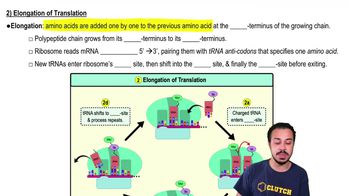
2) Elongation of Translation
13784
views
139
rank
2
comments
02:16
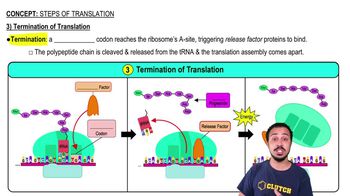
3) Termination of Translation
12923
views
108
rank
2
comments
05:03
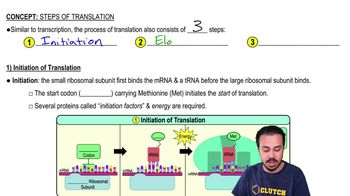
1) Initiation of Translation
15543
views
154
rank
2
comments
Terms in this set (15)
Hide definitions
What is the main structure involved in translation elongation?
The ribosome is the main structure involved in translation elongation.
During elongation, in which direction does the ribosome read the mRNA?
The ribosome reads the mRNA from the 5' end to the 3' end.
What is the role of tRNA anticodons during translation elongation?
tRNA anticodons pair with mRNA codons to specify the correct amino acid.
Where do charged tRNAs enter the ribosome during elongation?
Charged tRNAs enter the ribosome at the A site.
What type of bond forms between amino acids during translation elongation?
A peptide bond, which is a covalent bond, forms between amino acids.
What happens to the discharged tRNA after it has transferred its amino acid?
The discharged tRNA exits the ribosome through the E site.
What triggers the termination of translation?
A stop codon reaching the ribosome's A site triggers the termination of translation.
What binds to the stop codon during translation termination?
A release factor protein binds to the stop codon.
What happens to the polypeptide chain during translation termination?
The polypeptide chain is cleaved and released from the tRNA.
What happens to the ribosomal subunits after translation termination?
The small and large ribosomal subunits dissociate from each other.
What are post-translational modifications (PTMs)?
PTMs are covalent alterations that control the protein's activity after translation.
Name four common types of post-translational modifications.
Methylation, acetylation, ubiquitination, and phosphorylation.
What is the addition of a methyl group to a protein called?
The addition of a methyl group to a protein is called methylation.
What is the process of adding a lipid to a protein known as?
The process of adding a lipid to a protein is known as lipidation.
What does phosphorylation add to a protein?
Phosphorylation adds a phosphate group to a protein.
 BackBack

 04:59
04:59