Skip to main content
General Biology
My Course
Learn
Exam Prep
AI Tutor
Study Guides
Textbook Solutions
Flashcards
Explore
Try the app
My Course
Learn
Exam Prep
AI Tutor
Study Guides
Textbook Solutions
Flashcards
Explore
Try the app
Back
Terrestrial Biomes: Northern Regions quiz #1
You can tap to flip the card.
What are three abiotic factors commonly found in an Arctic ecosystem?
You can tap to flip the card.
👆
What are three abiotic factors commonly found in an Arctic ecosystem?
Three abiotic factors in an Arctic ecosystem are low temperatures, low precipitation, and permafrost (frozen soil).
Track progress
Control buttons has been changed to "navigation" mode.
1/10
Related flashcards
Related practice
Recommended videos
Terrestrial Biomes: Northern Regions exam
Terrestrial Biomes: Northern Regions
29 Terms
Terrestrial Biomes: Northern Regions definitions
Terrestrial Biomes: Northern Regions
15 Terms
Terrestrial Biomes: Northern Regions
48. Ecology
5 problems
Topic
Introduction to Aquatic Biomes
48. Ecology
5 problems
Topic
48. Ecology - Part 1 of 3
4 topics
12 problems
Chapter
Jason
48. Ecology - Part 2 of 3
4 topics
9 problems
Chapter
48. Ecology - Part 3 of 3
2 topics
5 problems
Chapter
00:58
Tundras
1537
views
11
rank
05:07
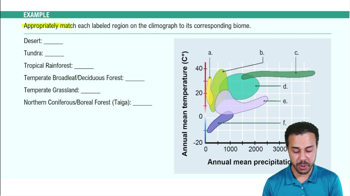
Terrestrial Biomes: Northern Regions Example 1
1462
views
7
rank
01:03
Northern Coniferous Forests (Boreal Forests/Taiga)
1732
views
7
rank
Terms in this set (10)
Hide definitions
What are three abiotic factors commonly found in an Arctic ecosystem?
Three abiotic factors in an Arctic ecosystem are low temperatures, low precipitation, and permafrost (frozen soil).
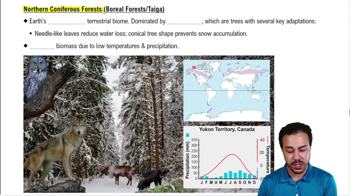
What adaptation helps conifer trees in boreal forests minimize water loss?
Conifer trees have needle-like leaves that reduce water loss. This adaptation is crucial for survival in cold, dry environments.
Why do coniferous trees in northern forests have a conical shape?
The conical shape prevents snow accumulation on branches. This allows more sunlight to reach the leaves for photosynthesis.
What is the primary reason for low biomass in northern coniferous forests?
Low temperatures and low precipitation limit the amount of life these forests can support. These harsh conditions reduce overall productivity.
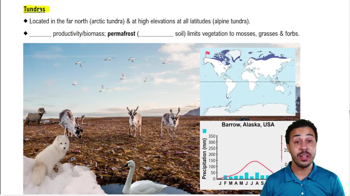
Where are Arctic tundras primarily located?
Arctic tundras are found in the far northern regions of the Earth. They are also present at high elevations as alpine tundras.
How does permafrost affect vegetation in tundra biomes?
Permafrost keeps the soil frozen, preventing significant tree growth. This results in landscapes dominated by mosses, grasses, and forbs.
What types of plants are most common in tundra regions?
Mosses, grasses, and forbs are the most common plants in tundra regions. These plants are adapted to survive in cold, nutrient-poor soils.
How do the climate graphs for northern coniferous forests and tundras compare?
Both climate graphs show low temperatures and low precipitation throughout the year. These conditions contribute to low productivity and biomass.
What is another name for northern coniferous forests?
Northern coniferous forests are also called boreal forests or taiga. These terms are used interchangeably to describe the same biome.
Why is biodiversity limited in both northern coniferous forests and tundras?
Extreme cold and low precipitation restrict the variety of species that can survive. This leads to limited biodiversity in both biomes.
 BackBack
 00:58
00:58