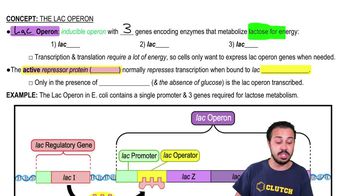
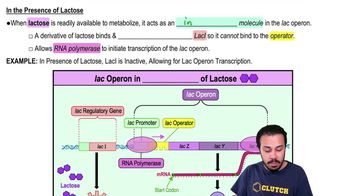
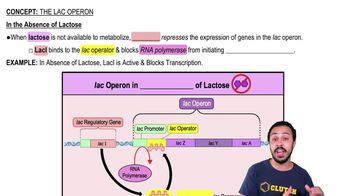
An inducible operon in E. coli that is repressed in the absence of lactose and activated in its presence to metabolize lactose.
Inducible Operon
An operon that is typically off but can be activated by an inducer molecule, allowing gene expression in response to specific environmental conditions.
Repressible Operon
A gene system that is typically active but can be inhibited when a specific molecule binds to a repressor, preventing transcription.
Lactose
A disaccharide sugar composed of glucose and galactose, metabolized by certain bacteria via the lac operon, which is activated in its presence.
Genes
Segments of DNA that encode instructions for synthesizing proteins or functional RNA molecules, influencing an organism's traits and biological functions.
Lac Z
A gene in the lac operon encoding -galactosidase, an enzyme that hydrolyzes lactose into glucose and galactose.
Lac Y
Lac Y encodes a permease that facilitates the transport of lactose into the bacterial cell, enabling its metabolism when lactose is present.
Lac A
Encodes thiogalactoside transacetylase, an enzyme involved in lactose metabolism within the lac operon, though its exact role in lactose utilization is less understood compared to LacZ and LacY.
Repressor Protein
A protein that binds to the operator region of an operon, blocking RNA polymerase and preventing transcription of specific genes, typically in the absence of an inducer.
Lac I
A protein that binds to the operator of the lac operon, inhibiting transcription in the absence of lactose.
Operator
A DNA segment in an operon where a repressor protein binds to inhibit transcription of adjacent genes.
RNA Polymerase
An enzyme that synthesizes RNA from a DNA template during transcription, essential for gene expression.
Transcription
The process where RNA polymerase synthesizes RNA from a DNA template, producing mRNA for protein synthesis.
Promoter
A DNA sequence where RNA polymerase binds to initiate transcription of a gene.
E. Coli
A common gut bacterium that utilizes the lac operon to metabolize lactose, becoming active in its presence and repressed in its absence.
Inducer Molecule
A molecule that binds to a repressor protein, preventing it from binding to the operator, thus allowing gene transcription in an inducible operon.
Metabolism
The set of chemical reactions in a cell that convert nutrients into energy and building blocks for growth, while also eliminating waste products.
 Back
Back

 04:34
04:34