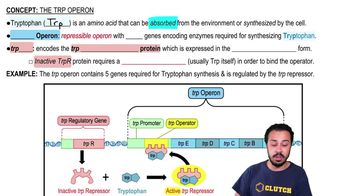
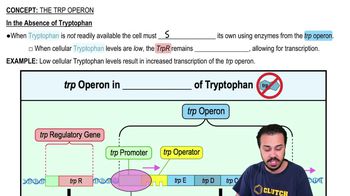
An essential amino acid that cells can absorb or synthesize; it acts as a corepressor in the trp operon, inhibiting its own synthesis when abundant.
Amino Acid
Organic compounds that serve as the monomers of proteins, each containing an amino group, a carboxyl group, and a unique side chain (R group) attached to a central carbon atom.
Monomers
Small molecules that can join together to form larger, complex structures like proteins, nucleic acids, or polysaccharides.
Proteins
Large biomolecules composed of amino acids, essential for cellular structure, function, and regulation, including enzymes, hormones, and antibodies.
Trp
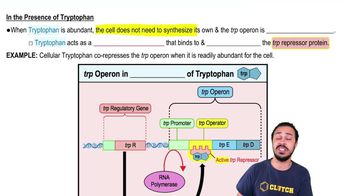
A repressible operon in bacteria that controls the synthesis of tryptophan, turning off gene expression when tryptophan is abundant by using tryptophan as a corepressor to activate the repressor protein.
Operon
A cluster of genes under a single promoter, regulated together, enabling coordinated expression of proteins, often involved in a specific metabolic pathway.
Repressible Operon
A genetic system usually active but can be turned off when a specific molecule binds to a repressor, inhibiting gene transcription.
Genes
Segments of DNA that encode instructions for synthesizing proteins or functional RNA molecules, influencing traits and cellular functions.
Enzymes
Biological catalysts that speed up chemical reactions by lowering activation energy, crucial for processes like metabolism and DNA replication.
Synthesis
The process of combining simpler molecules to form more complex molecules, often requiring energy and enzymes, as seen in the creation of tryptophan from basic substrates.
Operator
A DNA segment in an operon where a repressor protein binds to inhibit transcription of adjacent genes, regulating gene expression.
Regulatory Protein
A protein that binds to specific DNA sequences to control the transcription of genes, often by activating or repressing the process.
Promoter
A DNA sequence where RNA polymerase binds to initiate transcription of a gene or operon.
RNA Polymerase
An enzyme that synthesizes RNA from a DNA template during transcription, binding to the promoter region to initiate the process.
Regulatory Gene
A gene that encodes a protein or RNA molecule that regulates the expression of other genes, often by binding to specific DNA sequences and influencing transcription.
Repressor Protein
A protein that binds to an operator sequence in DNA to inhibit transcription, becoming active only when bound by a corepressor, such as tryptophan, to regulate gene expression.
Transcription
The process where RNA polymerase synthesizes RNA from a DNA template, producing a complementary RNA strand, typically mRNA, which carries genetic information for protein synthesis.
Corepressor
A molecule that binds to a repressor protein, activating it to inhibit gene transcription.
Cellular Tryptophan
An essential amino acid absorbed or synthesized by cells, acting as a corepressor to regulate its own synthesis by inhibiting the trp operon when abundant.
Environment
The surroundings and conditions in which an organism lives, including biotic and abiotic factors that influence its survival, development, and evolution.
Abundant
Present in large quantities, often to the extent that it influences biological processes or regulatory mechanisms within an organism.
Inactive Form
A protein state where it cannot bind to DNA or perform its function until activated by a specific molecule, such as a corepressor.
Active Form
The form of a protein that can bind to DNA and inhibit gene transcription, often requiring a corepressor to become functional.
Transcription Inhibition
The process by which a repressor protein, often activated by a corepressor, binds to an operator region on DNA, preventing RNA polymerase from transcribing specific genes.
Energy
The capacity to perform work or produce change, often measured in joules or calories, and essential for biological processes like metabolism and cellular functions.
Materials
Substances or components used by cells to perform functions, such as synthesizing molecules, maintaining structures, or facilitating biochemical reactions.
 Back
Back

 03:11
03:11