 Back
BackAnimal Behavior in General Biology
 07:15
07:15
Terms in this set (20)
Behavior is the sum of all an organism’s responses to stimuli, influenced by both genotype and environment.
Innate behaviors are fixed traits determined strongly by genotype and development, not learned.
Learning is the modification of behavior based on experience and environmental influence.
Proximate causation explains the immediate stimulus that triggers a behavior (short-term cause).
Ultimate causation explains the evolutionary history and adaptive value of a behavior (long-term cause).
A fixed action pattern is an innate behavior triggered by a specific stimulus and carried to completion.
Taxis is movement toward or away from a stimulus, such as moths flying toward light.
Habituation is a simple form of learning where an animal stops responding to a repeated, irrelevant stimulus.
Imprinting is a rapid, irreversible learning process during a critical period, often for parent-offspring bonding.
Associative learning involves linking one stimulus with another, including classical and operant conditioning.
Classical conditioning pairs an arbitrary stimulus with a response, like Pavlov’s dogs salivating to a bell.
Operant conditioning is trial-and-error learning where behavior is shaped by rewards or punishments.
Spatial learning is the ability to remember the location of objects or landmarks in the environment.
Cognition is reasoning and awareness, enabling problem-solving and observational learning.
Cross-fostering raises offspring of one species by another to separate genetic and environmental influences on behavior.
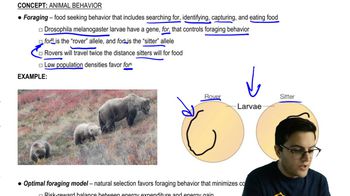
Optimal foraging theory predicts animals maximize energy gained while minimizing time and risk during food search.
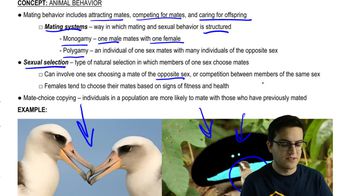
Mating systems include monogamy, polygyny, polyandry, and promiscuity, related to parental care needs.
Low certainty of paternity often reduces male parental care; males may evolve behaviors to increase paternity certainty.
Sexual selection is differential mating success leading to traits favored for attracting mates or competing with rivals.
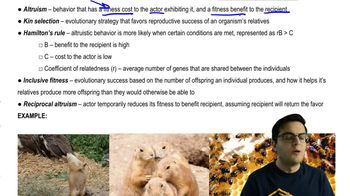
Altruism is behavior that lowers an individual's fitness but increases another's, posing an evolutionary paradox.