 Back
BackAnimal Reproduction and Development
 04:09
04:09
Terms in this set (27)
Reproduction without the union of gametes, producing genetically identical clones unless mutations occur.
A form of asexual reproduction where an individual divides into two, common in archaea, bacteria, and many protists.
Asexual reproduction where new individuals arise from outgrowths of existing ones, seen in sponges, jellyfish, and anemones.
A form of asexual reproduction where the body breaks into pieces, each capable of developing into an adult, requiring regeneration.
Union of male and female gametes to form a zygote, resulting in genetic recombination and variation among offspring.
Sexual females produce half as many daughters as asexual females, yet sexual reproduction persists due to genetic variation benefits.
A form of asexual reproduction where females produce offspring without fertilization, sometimes involving mating behaviors without males.
Condition where an individual has both male and female reproductive systems and can produce both types of gametes, allowing any two to mate.
Phenomenon where an individual changes sex during its lifetime, common in some fish and reptiles.
Fertilization occurring outside the female's body, common in aquatic animals where eggs and sperm are released into the environment.
Fertilization occurring inside the female reproductive tract, typical of reptiles, birds, and mammals.
Chemicals released by one organism to influence the physiology or behavior of another of the same species, often used in mating.
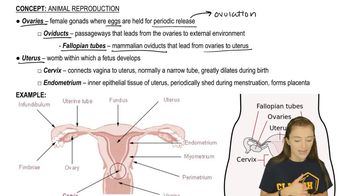
Organs that produce gametes; testes in males and ovaries in females.
The process of sperm production occurring in the seminiferous tubules of the testes.
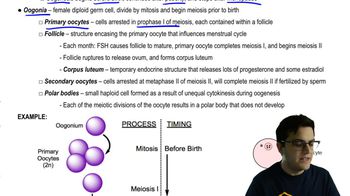
The process of egg (ovum) production in the ovaries, involving meiotic arrest stages.
FSH stimulates Sertoli cells to nourish sperm; LH stimulates Leydig cells to produce testosterone, promoting spermatogenesis.
FSH and LH regulate follicle growth and ovulation; estradiol and progesterone regulate the uterine cycle and feedback on hormone release.
A structure formed after fertilization that prevents polyspermy by blocking additional sperm entry.
Rapid cell divisions following fertilization that lead to the formation of a blastula.
Process during embryonic development where the blastula reorganizes into a multilayered structure with ectoderm, mesoderm, and endoderm.
The outer germ layer that forms the epidermis, nervous system, and sensory organs.
The middle germ layer that forms skeletal, muscular, circulatory, and excretory systems.
The inner germ layer that forms the lining of the digestive tract and associated organs.
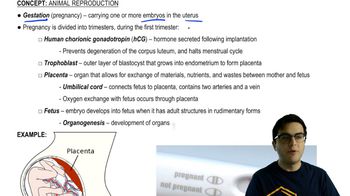
The period of carrying embryos in the uterus, varying in length among mammals.
Series of strong uterine contractions that expel the fetus and placenta during childbirth.
Production and secretion of milk by mammary glands, stimulated by prolactin and oxytocin.
Various methods to prevent fertilization or implantation, including condoms, birth control pills, IUDs, and surgical options.