Skip to main content
General Biology
My Course
Learn
Exam Prep
AI Tutor
Study Guides
Textbook Solutions
Flashcards
Explore
Try the app
My Course
Learn
Exam Prep
AI Tutor
Study Guides
Textbook Solutions
Flashcards
Explore
Try the app
Back
Carbohydrates in General Biology
You can tap to flip the card.
What are carbohydrates?
You can tap to flip the card.
👆
What are carbohydrates?
Carbohydrates
are organic molecules made of carbon, hydrogen, and oxygen, serving as energy sources and structural components in living organisms.
Track progress
Control buttons has been changed to "navigation" mode.
1/20
Recommended videos
03:08
Formation & Breakdown of Polysaccharides
22809
views
363
rank
04:53
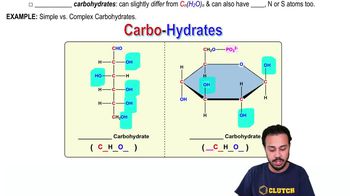
Carbohydrates
29924
views
454
rank
1
comments
05:08
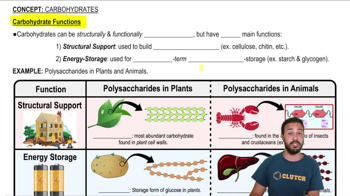
Carbohydrate Functions
21946
views
316
rank
Terms in this set (20)
Hide definitions
What are carbohydrates?
Carbohydrates
are organic molecules made of carbon, hydrogen, and oxygen, serving as energy sources and structural components in living organisms.
What are monosaccharides?
Monosaccharides
are the simplest carbohydrates, single sugar units like glucose, fructose, and galactose.
What is the difference between glucose, fructose, and galactose?
They are isomers with the same formula \(C_6H_{12}O_6\) but differ in structure and function.
What is the significance of glucose in the body?
Glucose
is the primary blood sugar and main energy source, converted into ATP for cellular activities.
What are disaccharides?
Disaccharides
are carbohydrates made of two monosaccharides joined by a glycosidic bond, e.g., sucrose, lactose, maltose.
What is a glycosidic linkage?
A
glycosidic linkage
is a covalent bond formed between two sugar molecules during a dehydration reaction.
What is sucrose composed of?
Sucrose
is a disaccharide made of glucose and fructose linked by a glycosidic bond.
What are oligosaccharides?
Oligosaccharides
are short chains of 3 to 10 sugar units involved in cell recognition and protection.
What roles do oligosaccharides play on cell surfaces?
They function in
cell adhesion
and
cell recognition
as part of glycoproteins on the plasma membrane.
What are polysaccharides?
Polysaccharides
are long chains of monosaccharides with storage or structural roles, e.g., starch, glycogen, cellulose.
How do starch and cellulose differ structurally?
Both are glucose polymers; starch has
alpha-1,4
linkages (branched/unbranched), cellulose has
beta-1,4
linkages forming straight chains.
What is glycogen?
Glycogen
is a highly branched glucose polymer used by animals for energy storage, mainly in liver and muscles.
What is the function of cellulose?
Cellulose
provides structural support in plant cell walls and is insoluble due to extensive hydrogen bonding.
Why can't most animals digest cellulose?
Animals lack enzymes to break
beta-1,4 glycosidic bonds
in cellulose, unlike starch which has alpha linkages.
What is the difference between amylose and amylopectin?
Amylose is unbranched starch with alpha-1,4 bonds; amylopectin is branched with alpha-1,6 bonds at branch points.
How do carbohydrates contribute to energy storage?
Excess glucose is stored as glycogen in animals and starch in plants for later energy use.
What is the role of carbohydrates in protein sparing?
Adequate carbohydrates prevent protein breakdown by providing sufficient energy.
How do carbohydrates aid in digestive health?
Dietary fiber, a carbohydrate, promotes bowel regularity and supports a healthy gut microbiome.
What is the chemical formula of glucose?
Glucose has the formula \(C_6H_{12}O_6\).
What are the two structural forms of glucose?
Glucose exists in
linear
and
ring
forms, with the ring form predominant in aqueous solutions.
 BackBack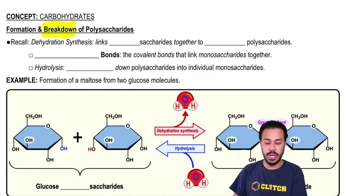
 03:08
03:08