 Back
BackCarbon and Molecular Diversity of Life
 03:35
03:35
Terms in this set (23)
Organic chemistry is the study of carbon-containing compounds, which form the foundation of biological molecules.
Miller's Experiment showed that organic compounds could be synthesized abiotically from inorganic precursors, supporting the idea that life's building blocks could form under early Earth conditions.
Carbon can form stable covalent bonds with many elements including hydrogen, oxygen, nitrogen, and other carbon atoms, allowing diverse molecular structures.
Examples include fructose and glucose (sugars), estradiol and testosterone (steroids), carbohydrates, lipids, and proteins.
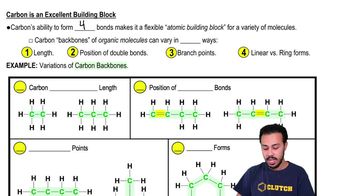
Carbon has four valence electrons, allowing it to form up to four covalent bonds with other atoms, creating chains, rings, and branched structures called carbon skeletons.
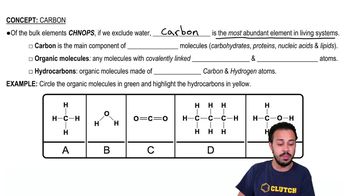
Hydrocarbons are molecules consisting entirely of carbon and hydrogen; they are nonpolar and hydrophobic.
Isomers are compounds with the same molecular formula but different structures, resulting in different properties.
Structural isomers differ in the covalent arrangements of their atoms.
Cis-trans isomers differ in spatial arrangement around a double bond.
Enantiomers are mirror images of each other due to the presence of an asymmetric (chiral) carbon atom.
Functional groups are groups of atoms that participate in chemical reactions and influence molecular function.
Hydroxyl groups are found in alcohols and increase solubility in water.
Carbonyl groups are found in aldehydes and ketones.
Carboxyl groups act as acids and are found in amino acids and fatty acids.
Amino groups act as bases and are found in amino acids.
Sulfhydryl groups are found in some amino acids and form disulfide bonds in proteins.
Phosphate groups are involved in energy transfer, such as in ATP.
Methyl groups affect gene expression and molecular recognition.
Steroids share a common carbon skeleton but differ in functional groups attached, leading to distinct biological activities.
ATP (Adenosine Triphosphate) is the primary energy carrier in cells; hydrolysis releases energy for cellular processes.
ATP + H\(2\)O → ADP + P\(i\) + energy
ATP hydrolysis powers muscle contraction, active transport, and biosynthesis.
Isomerism is key because different isomers can have drastically different biological effects, such as L- and D-amino acids.