Skip to main content
General Biology
My Course
Learn
Exam Prep
AI Tutor
Study Guides
Textbook Solutions
Flashcards
Explore
Try the app
My Course
Learn
Exam Prep
AI Tutor
Study Guides
Textbook Solutions
Flashcards
Explore
Try the app
Back
Cell Cycle and Mitosis - General Biology
You can tap to flip the card.
What is the primary role of cell division in unicellular organisms?
You can tap to flip the card.
👆
What is the primary role of cell division in unicellular organisms?
Reproduction
of the entire organism by division of one cell.
Track progress
Control buttons has been changed to "navigation" mode.
1/20
Recommended videos
04:46
Introduction to the Cell Cycle
19967
views
325
rank
1
comments
Terms in this set (20)
Hide definitions
What is the primary role of cell division in unicellular organisms?
Reproduction
of the entire organism by division of one cell.
What is the cell cycle?
The life of a cell from its formation to its own division, including growth and DNA replication.
What is the difference between somatic cells and gametes in terms of chromosome number?
Somatic cells are
diploid (2n)
with two sets of chromosomes; gametes are
haploid (n)
with half the chromosome number.
What is chromatin?
A complex of DNA and protein in eukaryotic cells that condenses to form chromosomes during cell division.
What are nucleosomes?
DNA wrapped around histone proteins, compacting DNA and regulating gene expression.
What are sister chromatids?
Identical copies of a chromosome joined at the centromere after DNA replication.
What is the centromere?
The region where sister chromatids are most closely attached.
What are the main phases of the cell cycle?
Interphase (G1, S, G2) for growth and DNA replication, and M phase for mitosis and cytokinesis.
What happens during the G1 phase?
Cell growth before DNA replication.
What occurs in the S phase of the cell cycle?
DNA replication and duplication of chromosomal proteins.
What is the function of the mitotic spindle?
Composed of microtubules, it controls chromosome movement during mitosis.
What are kinetochores?
Protein structures at the centromere where spindle microtubules attach.
What is the spindle checkpoint (SAC)?
A control point ensuring all chromosomes are properly attached to spindle fibers and aligned.
What enzyme cleaves cohesin to separate sister chromatids during anaphase?
Separase
cleaves cohesin, allowing chromatids to separate.
What occurs during telophase?
Chromosomes decondense, nuclear envelopes reform, and nucleoli reappear.
How does cytokinesis differ between animal and plant cells?
Animal cells form a cleavage furrow; plant cells form a cell plate.
What are cyclins and Cdks?
Cyclins are proteins whose levels fluctuate; Cdks are enzymes that phosphorylate proteins to drive cell cycle progression.
What is MPF?
Maturation-promoting factor, a cyclin-Cdk complex that triggers mitosis.
What is density-dependent inhibition?
A process where crowded cells stop dividing to prevent overgrowth.
What characterizes cancer cells in terms of cell cycle control?
They lose normal control, may produce their own growth factors, and can divide indefinitely.
 BackBack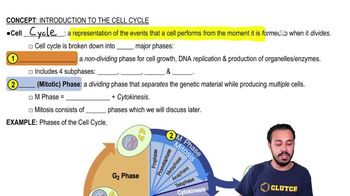
 04:46
04:46