 Back
BackCellular Reproduction and Cell Division
 04:45
04:45
Terms in this set (29)
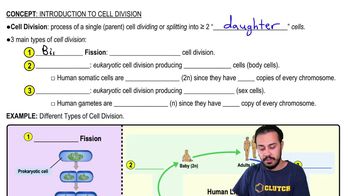
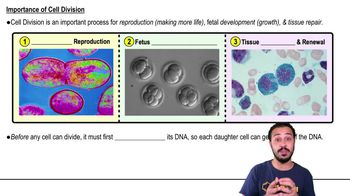
Cell division is the splitting of one parent cell into two genetically identical daughter cells.
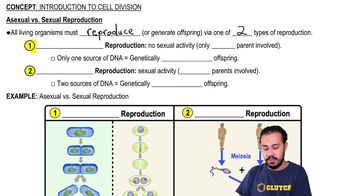
Asexual reproduction is cell division that results in the reproduction of a whole organism, producing genetically identical clones.
Sexual reproduction requires the fusion of gametes (egg and sperm cells) and produces offspring genetically different from parents.
Binary fission is the process by which prokaryotes divide, involving duplication and separation of a single circular DNA molecule.
Mitosis for growth and maintenance; Meiosis for producing gametes used in sexual reproduction.
Chromatin is the diffuse mass of DNA and proteins in the nucleus that coils into chromosomes when the cell prepares to divide.
Sister chromatids are two identical copies of a chromosome attached at the centromere.
Interphase (growth and DNA replication) and Mitotic phase (mitosis and cytokinesis).
G1: cell growth; S: DNA synthesis; G2: preparation for mitosis.
Mitosis divides the nucleus into two genetically identical nuclei through prophase, prometaphase, metaphase, anaphase, and telophase.
Chromatin coils into chromosomes; mitotic spindle forms; centrosomes begin to move apart.
Nuclear envelope breaks down; spindle microtubules attach to kinetochores on chromosomes.
Chromosomes align at the metaphase plate; spindle fibers attach to kinetochores from opposite poles.
Sister chromatids separate and move to opposite poles powered by motor proteins and ATP.
Chromosomes arrive at poles; nuclear envelopes reform; chromatin decondenses; mitotic spindle disappears.
Cytokinesis divides the cytoplasm. In animal cells, a cleavage furrow forms; in plant cells, a cell plate forms to create new cell walls.
Cells must be attached to a solid surface to divide, a property of most animal cells.
Crowded cells stop dividing when they touch each other, preventing overgrowth.
A mass of abnormally growing cells; benign tumors stay localized, malignant tumors can spread (metastasize).
Somatic cells are body cells with diploid chromosome number; gametes are haploid reproductive cells.
Pairs of chromosomes matching in length, centromere position, and gene loci, one from each parent.
Diploid (2n) cells have two sets of chromosomes; haploid (1n) cells have one set, as in gametes.
Exchange of chromosome segments between non-sister chromatids during prophase I of meiosis, increasing genetic variation.
Failure of chromosome pairs or sister chromatids to separate properly during meiosis, leading to abnormal gametes.
An ordered display of an individual's chromosomes arranged in pairs, used to detect abnormalities.
Trisomy 21: presence of three copies of chromosome 21, leading to developmental and physical effects.
Deletion, duplication, inversion, and translocation, which can cause birth defects or cancer.
Random orientation of homologous chromosome pairs during metaphase I of meiosis, contributing to genetic diversity.
Approximately 8.4 million, calculated as \(2^{23}\).