Skip to main content
General Biology
My Course
Learn
Exam Prep
AI Tutor
Study Guides
Textbook Solutions
Flashcards
Explore
Try the app
My Course
Learn
Exam Prep
AI Tutor
Study Guides
Textbook Solutions
Flashcards
Explore
Try the app
Back
ch.23
You can tap to flip the card.
Smallest unit of evolution
You can tap to flip the card.
👆
Smallest unit of evolution
The
population
is the smallest unit of evolution because evolution occurs as changes in allele frequencies within populations over time.
Track progress
Control buttons has been changed to "navigation" mode.
1/22
Recommended videos
Guided course
03:33
Evolution of Populations Example 1
3578
views
54
rank
Guided course
05:14
Introduction to Evolution of Populations
4547
views
86
rank
Terms in this set (22)
Hide definitions
Smallest unit of evolution
The
population
is the smallest unit of evolution because evolution occurs as changes in allele frequencies within populations over time.
Source of genetic variation in populations
Genetic variation arises through
mutations
,
gene flow
, and
sexual reproduction
. It is necessary for natural selection to act on.
Why genetic variation is necessary for natural selection
Without genetic variation, natural selection cannot favor certain traits, so populations cannot adapt or evolve.
Hardy-Weinberg equilibrium purpose
Used to calculate
allele
and
genotype frequencies
in a population and to determine if evolution is occurring.
Five conditions for Hardy-Weinberg equilibrium
No mutation, random mating, no gene flow, infinite population size, and no natural selection.
What happens if Hardy-Weinberg conditions are not met
Allele and genotype frequencies change over time, indicating that
evolution
is occurring.
Directional natural selection
Favors one extreme phenotype, causing a shift in the population's trait distribution.
Disruptive natural selection
Favors both extreme phenotypes and selects against intermediate phenotypes.
Stabilizing natural selection
Favors intermediate phenotypes and selects against extremes, reducing variation.
Balancing natural selection
Maintains multiple alleles in the population through mechanisms like heterozygote advantage.
Sexual selection definition
A form of natural selection where traits increase an individual's chances of mating.
Intrasexual selection
Competition between members of the same sex for mates.
Intersexual selection
Mate choice where one sex selects mates based on certain traits.
Is natural selection goal-oriented?
No, natural selection is not goal-oriented and cannot produce perfect organisms.
Effect of genetic drift in small populations
Genetic drift has a greater effect in small populations, causing random changes in allele frequencies.
Bottleneck effect
A sudden reduction in population size that reduces genetic variation due to genetic drift.
Founder effect
When a small group establishes a new population, leading to reduced genetic variation.
Gene flow (migration)
Movement of alleles between populations through migration, increasing genetic variation.
Fitness in evolutionary terms
An organism's ability to survive and reproduce, passing on its genes to the next generation.
Adaptation definition
A heritable trait that increases an organism's fitness in its environment.
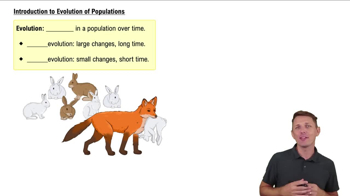
Microevolution vs. Macroevolution
Microevolution is change in allele frequencies within populations; macroevolution is large-scale evolutionary changes that can lead to new species.
Horizontal gene transfer
Transfer of genes between organisms in a manner other than traditional reproduction.
 BackBack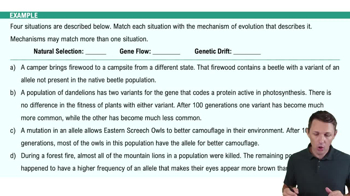
 03:33
03:33