 Back
Backch.24
 03:03
03:03
Terms in this set (26)
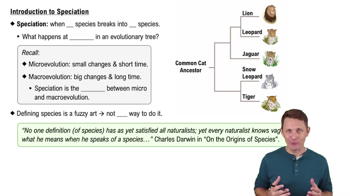
Species are groups of interbreeding natural populations that are reproductively isolated from other such groups.
Species are defined by distinct physical characteristics or morphology.
Species are groups adapted to a particular ecological niche or role.
Does not apply to asexual organisms or fossils; difficult to test reproductive isolation in some cases.
Can be subjective; cryptic species may look identical but are reproductively isolated.
Species may share niches or niches may change; ecological roles can overlap.
It prevents gene flow between populations, allowing independent evolution and speciation.
Include temporal, habitat, behavioral, mechanical, and gametic isolation that prevent mating or fertilization.
Include reduced hybrid viability, reduced hybrid fertility, and hybrid breakdown after fertilization.
Populations breed at different times or seasons, preventing mating.
Populations live in different habitats and rarely meet to mate.
Differences in mating behaviors or signals prevent interbreeding.
Structural differences in reproductive organs prevent successful mating.
Sperm and egg of different species are incompatible, preventing fertilization.
Hybrid offspring fail to develop properly or survive to reproductive age.
Hybrids are sterile or have reduced fertility, e.g., mule from horse and donkey.
Hybrids are fertile but their offspring have reduced viability or fertility.
New species arise within the same geographic area, often via polyploidy or disruptive selection.
New species form due to geographic isolation preventing gene flow between populations.
Region where two species meet and interbreed, producing hybrids.
Condition of having extra sets of chromosomes, often causing instant reproductive isolation.
Offspring resulting from mating between two different species or genetically distinct populations.
Interactions or variation occurring within a single species.
Interactions or variation occurring between different species.
Rapid evolution of many species from a common ancestor, often after colonizing new environments.
Allopatric speciation is the most common way new species arise.