How did eukaryotic cells evolve from prokaryotic cells?
Eukaryotic cells evolved through endosymbiosis, where a prokaryotic cell engulfed another, forming organelles like mitochondria and chloroplasts as endosymbionts.
What are biases of the fossil record?
The fossil record is biased toward organisms with hard parts, those living in environments favoring fossilization, and more recent species, causing incomplete preservation.
What are the main steps necessary for the evolution of life on Earth?
Key steps include formation of protocells, development of self-replicating molecules like ribozymes, and emergence of cellular life in oceans.
What is the approximate age of the Earth?
The Earth is about 4.5 billion years old.
When did prokaryotes first appear?
Prokaryotes appeared roughly 3.5 to 4 billion years ago.
When did eukaryotes first appear?
Eukaryotes appeared about 1.5 to 2 billion years ago.
When did multicellular eukaryotes appear?
Multicellular eukaryotes appeared around 1 billion years ago.
When did animals first appear?
Animals appeared approximately 600 million years ago.
When did land plants first appear?
Land plants appeared about 470 million years ago.
When did humans first appear?
Humans appeared roughly 200,000 to 300,000 years ago.
How has Earth's environment changed over its history?
Earth's environment changed from a hot, volcanic atmosphere to oxygen-rich air, with major events like ice ages and mass extinctions affecting life.
How do major environmental changes affect living organisms?
Environmental changes drive evolution by creating new selection pressures, causing extinctions, and enabling adaptive radiations.
How can the age of a fossil be estimated using radiometric dating?
Radiometric dating measures decay of radioactive isotopes to calculate absolute fossil age.
How does fossil depth in sedimentary rock relate to species age?
Deeper fossils are generally older, providing a relative timeline of species existence.
Where did the first living cells evolve?
The first living cells evolved in the oceans.
How does spatial gene expression affect pattern formation?
Spatial gene expression controls where and when genes activate, shaping organism development and body patterns.
Why does early development help understand evolutionary relationships?
Similarities in early development reveal common ancestry and evolutionary links among species.
Why is evolution not goal-oriented?
Evolution lacks a predetermined direction; it results from natural selection acting on random variation.
Define protocells.
Protocells are simple, membrane-bound structures that exhibit some life-like properties, precursors to true cells.
What are hydrothermal vents?
Hydrothermal vents are underwater fissures emitting hot, mineral-rich water, possibly sites for origin of life.
What are alkaline vents?
Alkaline vents are underwater vents with high pH, proposed as environments for early biochemical reactions.
What are ribozymes?
Ribozymes are RNA molecules with catalytic activity, capable of self-replication and biochemical reactions.
What is an endosymbiont?
An endosymbiont is an organism living inside another, such as mitochondria inside eukaryotic cells.
What was the Cambrian explosion?
The Cambrian explosion was a rapid diversification of animal life about 540 million years ago.
Define unicellular and multicellular organisms.
Unicellular organisms consist of a single cell; multicellular organisms have many specialized cells.
What is a prokaryote?
A prokaryote is a single-celled organism without a nucleus or membrane-bound organelles.
What is a eukaryote?
A eukaryote is an organism with cells containing a nucleus and membrane-bound organelles.
What is adaptive radiation?
Adaptive radiation is rapid evolution of diverse species from a common ancestor in response to new environments.
What is half-life in radiometric dating?
Half-life is the time it takes for half of a radioactive isotope to decay, used to date fossils.
 Back
Back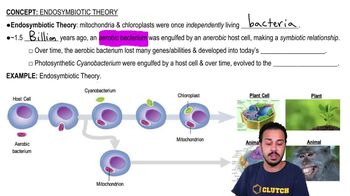
 06:58
06:58