Skip to main content
General Biology
My Course
Learn
Exam Prep
AI Tutor
Study Guides
Textbook Solutions
Flashcards
Explore
Try the app
My Course
Learn
Exam Prep
AI Tutor
Study Guides
Textbook Solutions
Flashcards
Explore
Try the app
Back
Ch.5 Cell Membrane Structure & Transport Processes
You can tap to flip the card.
Phospholipid structure
You can tap to flip the card.
👆
Phospholipid structure
Phospholipids have a hydrophilic phosphate head and two hydrophobic fatty acid tails, forming the basic structure of cell membranes.
Track progress
Control buttons has been changed to "navigation" mode.
1/21
Recommended videos
02:21
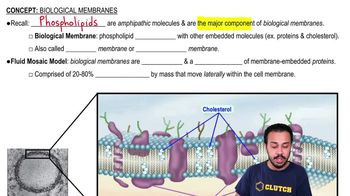
Biological Membranes Example 1
24679
views
457
rank
1
comments
06:04
Biological Membranes
33823
views
687
rank
2
comments
Terms in this set (21)
Hide definitions
Phospholipid structure
Phospholipids have a hydrophilic phosphate head and two hydrophobic fatty acid tails, forming the basic structure of cell membranes.
Phospholipid bilayer
Cell membranes consist of a phospholipid bilayer with hydrophilic heads facing outward and hydrophobic tails facing inward.
Fluid mosaic model
Describes the plasma membrane as a fluid combination of phospholipids, cholesterol, and proteins that move laterally.
Integral membrane proteins
Proteins embedded within the membrane with hydrophilic and hydrophobic regions, often forming channels or carriers.
Peripheral membrane proteins
Proteins attached to the membrane surface, not embedded, often involved in signaling or structural support.
Cholesterol role in membranes
Cholesterol in animal membranes provides flexibility and stability by preventing tight packing of phospholipids.
Selective permeability
The plasma membrane allows some molecules to pass while blocking others based on size, charge, and polarity.
Diffusion
Passive movement of molecules from high to low concentration without energy input.
Osmosis
The diffusion of water across a selectively permeable membrane from low to high solute concentration.
Isotonic solution
A solution with equal solute concentration compared to the cell, causing no net water movement.
Hypertonic solution
A solution with higher solute concentration than the cell, causing water to leave the cell and shrink.
Hypotonic solution
A solution with lower solute concentration than the cell, causing water to enter the cell and swell.
Facilitated diffusion
Passive transport of polar or charged molecules across membranes via specific transport proteins.
Active transport
Energy-requiring process where molecules move against their concentration gradient using transport proteins and ATP.
Exocytosis
Process where cells export large molecules by vesicles fusing with the plasma membrane.
Endocytosis
Process where cells engulf large molecules by forming vesicles from the plasma membrane.
Phagocytosis
A type of endocytosis where the cell engulfs large particles or cells ('cell eating').
Receptor-mediated endocytosis
Selective uptake of molecules using receptors on the cell surface that trigger vesicle formation.
Concentration gradient
Difference in molecule concentration across a space or membrane driving diffusion.
Role of transport proteins
Transport proteins assist in moving substances that cannot diffuse freely through the lipid bilayer.
Effect of tonicity on plant cells
In hypotonic solutions, plant cells become turgid; in hypertonic, they plasmolyze; isotonic causes flaccidity.
 BackBack
 02:21