 Back
BackChapter 1-5
 02:09
02:09

Terms in this set (37)
What is a biosphere?
The term for all places that life exists on earth. (or just earth)
What is an ecosystem?
An ecosystem consists of all living things in a particular area, along with nonliving components of the environment in which the living things interact with, soil water, gases and light.
What is a community?
An array of organisms inhabiting a particular ecosystem.
What is a population?
All the individuals of a particular species living in the bounds of a specified area.
What are organisms?
Individual living things are called organisms.
What are organs?
An organ is a body part that is made up of multiple tissues and has specific functions in the body. Ex stems, roots, leaves.
What are tissues?
Tissues are groups of cells that work together to perform a specialized function, like skin or arteries.
What is a cell?
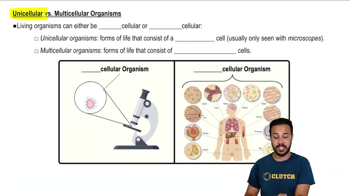
A cell is the fundamental unit of structure and function for life, or the smallest individual unit of an organism.
What are organelles?
Organelles are functional components of cells. Ex chloroplast or mitochondria or nucleus.
What are molecules?
A molecule is a chemical structure consisting of two or more atoms.
What are emergent properties?
New properties that arise with each step upward in the hierarchy of life, owing to the arrangement and interactions of parts as complexity increases.
What is systems biology?
An approach to studying biology that aims to model the dynamic behavior of whole biological systems based on a study of the interactions among the system’s parts.
What is a eukaryotic cell?
A A type of cell with a membrane-enclosed nucleus and membrane-enclosed organelles. Organisms with eukaryotic cells (protists, plants, fungi, and animals) are called eukaryotes.
Prokaryotic cell
A type of cell lacking a membrane-enclosed nucleus and membrane-enclosed organelles. Organisms with prokaryotic cells (bacteria and archaea) are called prokaryotes.
What is DNA and what does it do?
deoxyribonucleic acid is a long molecule used to transmit genetic information during cell division.
What are DNA chains made of?
Nucleotides, A,T,C, and G
What is gene expression?
The entire process by which information in a gene directs the manufacture of a cellular product.
What are the three stages of molecular gene expression?
Transcription, Translation, and Protein folding. Using DNA information, the cell makes (transcribes) mRNA. The cell translates the mRNA to make a protein, a series of linked amino acids. The chain of amino acids folds into a specific shape of some protein.
What is a genome?
The entire "library" of genetic instructions that an organism inherits. A typical human cell has two similar sets of chromosomes, and each set has approximately 3 billion nucleotide pairs of DNA. The researchers who study it study genomics.
What is proteomics?
The study of sets of proteins and their properties. (The entire set of proteins expressed by a given cell, tissue, or organism is called a proteome.)
What is bioinformatics?
The use of computers, software, and mathematical models to process and integrate biological information from large data sets.
What are producers and consumers?
Producers are organisms that absorb sunlight or get their nutrients from the ambient planet. Consumers are organisms that feed on other organisms or their remains.
What is feedback regulation?
The regulation of a process by its output or end product.
What is evolution?
A process of biological change in which species accumulate differences from their ancestors as they adapt to different environments over time.
What are the three Domains? Which one do we belong to?
Bacteria, Archaea, and Eukarya.
Humans are in domain Eukarya.
What are the four Kingdoms?
Plantae, Fungi, Animalia, Protists
What is natural selection?
A mechanism of evolutionary adaptation that occurs because the natural environment consistently selects for the propagation of certain traits among naturally occurring variant traits in the population.
What is qualitative data? List an example
What is quantitative data?
An observational item of information that isn't numerical. Blue feathers.
Numerical items of information.
What is inductive reasoning?
A type of logic in which generalizations are based on a large number of specific observations.
What is a hypothesis? Can it be proven?
A hypothesis is an explanation, based on observations and assumptions, that leads to a testable prediction. Said another way, a hypothesis is an explanation on trial.
No, it can only be falsified.
What is an experiment?
An experiment is a scientific test, carried out under controlled conditions.
What is deductive reasoning?
A type of logic in which specific results are predicted from a general premise. Ex: If the burnt-out bulb hypothesis is correct, then the lamp should work if you replace the bulb with a new one.
What is a controlled experiment?
An experiment designed to compare an experimental group with a control group; ideally, the two groups differ only in the factor being tested.
In a controlled experiment, what is a variable? What are independent and dependent variables?
A feature or quantity that varies in an experiment. The independent variable is the factor being manipulated by the researchers. The dependent variable is the factor being measured that is predicted to be affected by the independent variable.
How do researchers "control" unwanted variables in their experiments?
The use of control groups can cancel out the effects of unwanted variables in an experiment.
What is a scientific theory?
An explanation that is broader in scope than a hypothesis, generates new hypotheses, and is supported by a large body of evidence.
What is a model organism? List an example.
A species that is easy to grow in the lab and lends itself particularly well to the questions being investigated.
the fruit fly Drosophila melanogaster, the mouse Mus musculus,