 Back
BackChapter 1: General Biology: Evolution, Themes, and Scientific Inquiry
 02:09
02:09

Terms in this set (24)
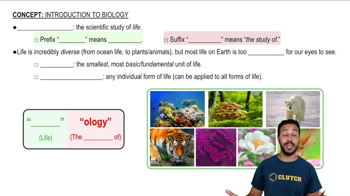
Biology is the scientific study of life, recognized by what living things do.
Organization, Information, Energy and Matter, Interactions, Evolution.
Reductionism is an approach that reduces complex systems to simpler components for study.
Emergent properties arise from the arrangement and interaction of parts as complexity increases.
At each biological level, structure correlates with function; knowing one provides insight into the other.
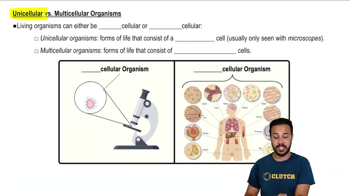
All living organisms are made of cells, the smallest units that perform all life activities.
Prokaryotic cells lack a nucleus and membrane-bound organelles; eukaryotic cells have both.
DNA contains genetic material organized in chromosomes and encodes information for building molecules.
DNA is a double helix made of two chains of nucleotides: A, G, C, and T.
Gene expression is the process of transcribing DNA into RNA and translating RNA into proteins.
Genomics studies whole sets of genes; proteomics studies whole sets of proteins.
Energy enters as sunlight, is converted by producers, passed to consumers, and lost as heat.
Feedback regulation controls biological processes; negative feedback reduces initial stimulus, positive feedback amplifies it.
Bacteria, Archaea (both prokaryotes), and Eukarya (eukaryotes).
Plants, Fungi, Animals, and Protists.
Evolution is the modification of species over time from common ancestors.
Descent with modification and natural selection as the mechanism.
Individuals with advantageous traits survive and reproduce more, increasing those traits in the population.
A testable explanation based on observations that leads to predictions.
Inductive reasoning derives generalizations from observations; deductive reasoning makes specific predictions from general premises.
Peer review vets research before publication to ensure validity and reliability.
Model organisms help study biological processes applicable to other species.
Science seeks to understand natural phenomena; technology applies scientific knowledge for practical purposes.
Diverse backgrounds and viewpoints enhance scientific creativity, robustness, and productivity.