 Back
BackChapter 1 Review
 01:35
01:35
Terms in this set (20)
Biology is the scientific study of life.
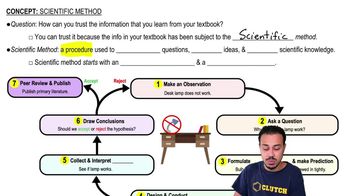
Observation, Question, Hypothesis, Prediction, Experiment, and then Revise and Repeat.
It tests two or more groups differing in one variable; the control group does not receive the change, while the experimental group does.
An experiment where information about the tests is withheld from participants and/or experimenters to prevent bias.
A broad, comprehensive statement supported by a large amount of verifiable evidence.
A piece of information that can be verified by any independent observer.
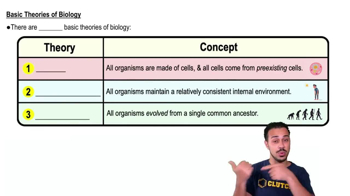
Order, regulation, growth and development, energy processing, response to environment, reproduction, evolution, and cells.
At all levels, structure and function are related; changes in structure often alter function.
Genes store, transmit, and use information to build proteins that perform life’s tasks.
Energy flows through ecosystems while nutrients are recycled within them.
Life is studied at many levels, from molecules to the biosphere, where complexity leads to new properties.
Descent with modification through natural selection, where unequal reproductive success leads to adaptations.
The process of unequal reproductive success that causes populations to adapt to their environment over time.
The cell.
Hypotheses are narrow, testable ideas; theories have broad explanatory power and are supported by extensive evidence.
Evolution.
A fact can be independently verified; an opinion cannot.
Hypothesis: testable idea; Evolution: descent with modification; Natural Selection: unequal reproductive success; Biosphere: all life-supporting environments on Earth.
It helps improve fruit and vegetable production, understand human development and disease, and advances basic biology knowledge.
The number of nests increased significantly from 1985 to around 2010, indicating population recovery efforts.