 Back
BackChapter 4: Carbon and Molecular Diversity of Life - General Biology
 03:35
03:35
Terms in this set (20)
Organic chemistry is the study of compounds that contain carbon, regardless of origin, ranging from simple molecules to colossal ones.
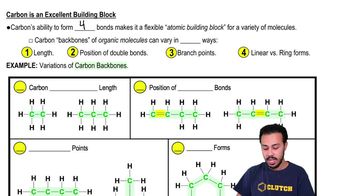
Carbon's ability to form four covalent bonds allows it to create a vast diversity of organic molecules essential for life.
It demonstrated the abiotic synthesis of organic compounds under early Earth-like conditions, supporting theories on the origin of life.
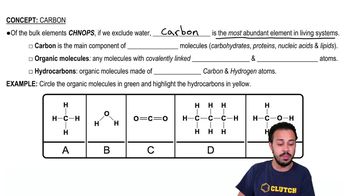
The major elements are carbon (C), hydrogen (H), oxygen (O), nitrogen (N), sulfur (S), and phosphorus (P), with carbon being central.
Carbon has four valence electrons, enabling it to form four covalent bonds with various atoms, creating complex molecules.
They form a tetrahedral shape, but when joined by a double bond, the atoms lie in the same plane as the carbons.
Carbon has a valence of 4, meaning it can form four covalent bonds with other atoms.
Hydrocarbons are organic molecules consisting only of carbon and hydrogen, often found in fats and can release large amounts of energy.
Isomers are compounds with the same molecular formula but different structures and properties.
Structural isomers differ in covalent arrangements, cis-trans isomers differ in spatial arrangement around double bonds, and enantiomers are mirror images.
Enantiomers can have different biological effects, with often only one being biologically active.
The carbon skeleton and the attached functional chemical groups determine the molecule's properties.
Functional groups are components of organic molecules involved in chemical reactions and give molecules unique properties.
Hydroxyl, Carbonyl, Carboxyl, Amino, Sulfhydryl, Phosphate, and Methyl groups.
Adenosine triphosphate (ATP) is an organic phosphate molecule that stores energy for cellular processes by reacting with water.
ATP reacts with water, breaking a phosphate bond to form ADP, inorganic phosphate, and releasing energy.
A covalent bond joins functional groups to the carbon skeleton of large molecules.
The amino group acts as a base by accepting protons.
Carbon skeletons vary in length, branching, double bond position, and presence of rings.
Urea's molecular formula is CO(NH2)2, containing carbon, oxygen, and nitrogen atoms.