Skip to main content
General Biology
My Course
Learn
Exam Prep
AI Tutor
Study Guides
Textbook Solutions
Flashcards
Explore
Try the app
My Course
Learn
Exam Prep
AI Tutor
Study Guides
Textbook Solutions
Flashcards
Explore
Try the app
Back
Chapter 5
You can tap to flip the card.
Amphipathic molecule
You can tap to flip the card.
👆
Amphipathic molecule
A molecule with both
hydrophilic
(water-loving) and
hydrophobic
(water-fearing) parts.
Track progress
Control buttons has been changed to "navigation" mode.
1/22
Recommended videos
02:21
Biological Membranes Example 1
24681
views
457
rank
1
comments
06:04
Biological Membranes
33825
views
687
rank
2
comments
Terms in this set (22)
Hide definitions
Amphipathic molecule
A molecule with both
hydrophilic
(water-loving) and
hydrophobic
(water-fearing) parts.
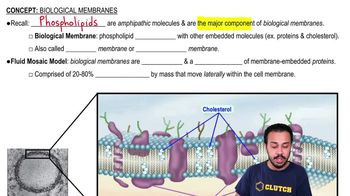
Primary component of biological membranes
Phospholipids
form the main structure of biological membranes.
Phospholipid bilayer
A
double layer
of phospholipids that makes up plasma and organelle membranes.
Fluid mosaic model
Describes membranes as a
dynamic structure
where molecules move laterally, creating a fluid-like nature.
Protein content in biological membranes
Biological membranes can be made up of
20-80%
proteins.
Selective permeability
The membrane's ability to
regulate passage
of substances in and out of the cell.
Role of cholesterol in membranes
Cholesterol helps to
stabilize membrane fluidity
.
Embedded proteins
Proteins inserted into the phospholipid bilayer that can move laterally and perform various functions.
Other terms for biological membranes
Also called
cell membranes
or
plasma membranes
.
Hydrophilic
Water-loving; refers to the
polar head
of a phospholipid.
Hydrophobic
Water-fearing; refers to the
non-polar tail
of a phospholipid.
Meaning of 'bi' in bilayer
Means
two
, indicating two layers of phospholipids.
Mosaic in fluid mosaic model
Refers to the membrane being made of many different parts like proteins and lipids.
Function of biological membranes
To
control passage
of molecules into and out of the cell, like the skin of the body.
Carbohydrate groups in membranes
Attached to proteins and lipids; involved in
cell recognition and signaling
.
What allows membrane fluidity?
The
lateral movement
of phospholipids and proteins within the bilayer.
Significance of amphipathic phospholipids
Allows formation of bilayers with hydrophilic heads outward and hydrophobic tails inward.
Cholesterol in animal cell membranes
A lipid interspersed in the bilayer that contributes to
membrane fluidity
.
Main function of embedded proteins
Perform
transport, signaling,
and
structural support
roles.
Semi-fluid nature of membranes
Membranes are not fixed; molecules can
move around
within the bilayer.
Implication of fluid mosaic model
Membranes are composed of various molecules that
move and shift
, creating a flexible structure.
Role of carbohydrate groups on membrane proteins and lipids
Involved in
cell recognition
and
signaling
.
 BackBack

 02:21