Skip to main content
General Biology
My Course
Learn
Exam Prep
AI Tutor
Study Guides
Textbook Solutions
Flashcards
Explore
Try the app
My Course
Learn
Exam Prep
AI Tutor
Study Guides
Textbook Solutions
Flashcards
Explore
Try the app
Back
Chromosomal Basis of Inheritance - General Biology
You can tap to flip the card.
Chromosome Theory of Inheritance
You can tap to flip the card.
👆
Chromosome Theory of Inheritance
States that genes are located on chromosomes and that the behavior of chromosomes during meiosis accounts for inheritance patterns.
Track progress
Control buttons has been changed to "navigation" mode.
1/24
Recommended videos
02:09
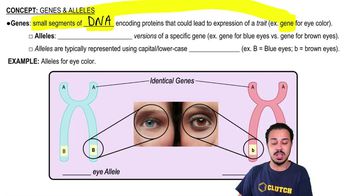
Genes & Alleles Example 1
10869
views
177
rank
05:02
Genes & Alleles
16391
views
240
rank
2
comments
04:14
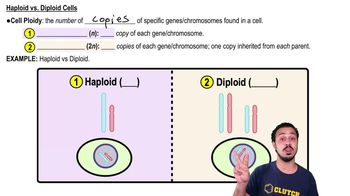
Haploid vs. Diploid Cells
14436
views
245
rank
Terms in this set (24)
Hide definitions
Chromosome Theory of Inheritance
States that genes are located on chromosomes and that the behavior of chromosomes during meiosis accounts for inheritance patterns.
Why are fruit flies a good model organism for genetic studies?
They have many offspring, breed every two weeks, and have only four pairs of chromosomes.
Wild type vs. Mutant in Drosophila
Wild type refers to the normal phenotype, while mutant refers to an altered phenotype due to a genetic mutation.
Morgan's experiment with white-eyed Drosophila
Showed that the white eye trait is X-linked recessive, as only males with the Xw allele showed white eyes.
X-linked recessive traits examples
Color blindness, Duchenne muscular dystrophy, and hemophilia are caused by X-linked recessive alleles.
Hemizygous definition
Having only one allele for a gene in a diploid organism, such as males for X-linked genes.
Cross that cannot produce white-eyed male Drosophila
Cross between homozygous red-eyed females and white-eyed males cannot produce white-eyed males.
Chromosomal sex determination systems
Include X-Y system, X-0 system, Z-W system, and haplo-diploid system.
Barr body
An inactivated X chromosome in female mammals that forms a dense body in the nucleus.
Effect of linkage between two genes on inheritance
Linked genes tend to be inherited together, deviating from the expected 1:1:1:1 ratio of independent assortment.
Genetic recombination frequency for unlinked genes
Parental and recombinant types occur at approximately 50% frequency each.
Genetic recombination frequency for linked genes
Recombinant types occur less than 50%, indicating genes are physically close on the same chromosome.
Genetic map (linkage map)
A map showing the relative positions of genes on a chromosome based on recombination frequencies.
Map unit definition
One map unit corresponds to a 1% recombination frequency between two genes.
Aneuploidy
The presence of an abnormal number of chromosomes in a cell, such as monosomy or trisomy.
Polyploidy
Having more than two complete sets of chromosomes, e.g., triploidy (3n) or tetraploidy (4n).
Down syndrome cause
Trisomy 21, an extra copy of chromosome 21.
Klinefelter syndrome
A condition in males with an extra X chromosome (XXY).
Turner syndrome
A condition in females with only one X chromosome (XO).
Types of chromosomal structural alterations
Deletion, duplication, inversion, and translocation.
Cri du chat syndrome
A disorder caused by a deletion on chromosome 5.
Chronic myelogenous leukemia (CML)
Caused by a translocation between chromosomes 9 and 22.
Genomic imprinting
An epigenetic phenomenon where expression of an allele depends on its parental origin.
Nondisjunction
Failure of homologous chromosomes or sister chromatids to separate properly during meiosis.
 BackBack
 02:09
02:09