Skip to main content
General Biology
My Course
Learn
Exam Prep
AI Tutor
Study Guides
Textbook Solutions
Flashcards
Explore
Try the app
My Course
Learn
Exam Prep
AI Tutor
Study Guides
Textbook Solutions
Flashcards
Explore
Try the app
Back
Circulation and Gas Exchange in General Biology
You can tap to flip the card.
What are the three main exchange mechanisms organisms use to exchange materials with their environment?
You can tap to flip the card.
👆
What are the three main exchange mechanisms organisms use to exchange materials with their environment?
Direct exchange
,
gastrovascular cavity
, and
circulatory system
.
Track progress
Control buttons has been changed to "navigation" mode.
1/28
Recommended videos
02:15
Lymphatic System
3185
views
13
rank
06:24
Lung Anatomy
2923
views
11
rank
06:28
Gas Exchange and Circulation
4886
views
58
rank
Terms in this set (28)
Hide definitions
What are the three main exchange mechanisms organisms use to exchange materials with their environment?
Direct exchange
,
gastrovascular cavity
, and
circulatory system
.
When does direct exchange occur in organisms?
When bodies are 1–2 cell layers thick, allowing substances to diffuse directly across the body surface, e.g., Hydra.
What is the function of a gastrovascular cavity?
It functions in both digestion and distribution of substances throughout the body.
What are the two types of circulatory systems?
Open circulatory system
and
closed circulatory system
.
What are the three basic components of both open and closed circulatory systems?
A circulatory fluid (blood or hemolymph), a set of tubes (blood vessels), and a muscular pump (the heart).
What type of circulatory system do humans and other vertebrates have?
A
closed circulatory system
, also called the cardiovascular system.
Name the three main types of blood vessels in vertebrates.
Arteries
,
veins
, and
capillaries
.
Describe single circulation in bony fishes, rays, and sharks.
Blood passes through a two-chambered heart and flows through two capillary beds before returning to the heart.
What is double circulation and which animals have it?
Double circulation has two circuits: pulmonary (to lungs/skin) and systemic (to body). Found in amphibians, reptiles, and mammals.
What is the role of the pulmonary circuit in double circulation?
It pumps deoxygenated blood from one side of the heart to the lungs or skin for oxygenation.
What is the role of the systemic circuit in double circulation?
It pumps oxygen-rich blood from the other side of the heart to the rest of the body.
What are the four chambers of the mammalian heart?
Right atrium, right ventricle, left atrium, and left ventricle.
What is the function of semilunar valves in the heart?
They prevent backflow of blood from arteries into ventricles during ventricular diastole.
What is the sinoatrial (SA) node?
The pacemaker of the heart that generates electrical signals to initiate heart contractions.
What is the function of capillaries in the circulatory system?
They facilitate exchange of gases, nutrients, and wastes between blood and body tissues.
How does blood pressure change as blood flows from arteries to veins?
Blood pressure decreases progressively from arteries to arterioles, capillaries, venules, and veins.
What role do precapillary sphincters play in blood flow?
They regulate blood flow into capillary beds by contracting or relaxing.
What is the function of the lymphatic system?
It returns fluid that leaks out of capillaries back to the circulatory system and helps in immune defense.
What are the main components of blood plasma?
About 90% water, inorganic ions, plasma proteins (albumin, fibrinogen, immunoglobulins), nutrients, wastes, gases, and hormones.
What are the three cellular elements suspended in blood plasma?
Red blood cells (erythrocytes), white blood cells (leukocytes), and platelets.
What is the primary function of erythrocytes?
To transport oxygen and help transport carbon dioxide.
What is the role of leukocytes?
They function in defense and immunity.
How do platelets contribute to blood clotting?
Platelets release chemicals that make nearby platelets sticky and initiate clotting factor cascades.
What hormone stimulates erythrocyte production?
Erythropoietin (EPO), which is released when oxygen delivery is low.
What is the Bohr shift in hemoglobin function?
CO2 produced during respiration lowers blood pH, decreasing hemoglobin's affinity for oxygen and enhancing O2 delivery.
How is carbon dioxide transported in the blood?
CO2 is transported dissolved in plasma, bound to hemoglobin, and as bicarbonate ions formed by carbonic acid.
What adaptations help diving mammals store oxygen?
High blood to body volume ratio and oxygen storage in muscle myoglobin proteins.
Why does air hold more oxygen per unit volume than water?
Because oxygen solubility in water decreases with temperature and water holds less oxygen than air at the same temperature and pressure.
 BackBack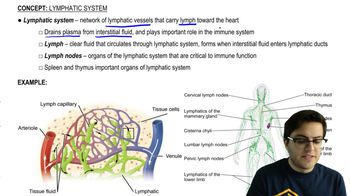
 02:15
02:15