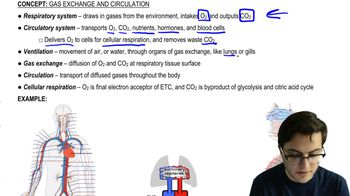
Facilitate exchange of resources and wastes between cells and the environment, especially in larger multicellular organisms.
Difference between open and closed circulatory systems
Open systems have hemolymph in direct contact with organs; closed systems have blood confined to vessels, allowing faster oxygen delivery.
Three basic components of specialized circulatory systems
Circulatory fluid, interconnecting vessels, and a muscular pump (heart).
Role of hemoglobin in blood
A respiratory pigment in red blood cells that reversibly binds oxygen, increasing oxygen transport efficiency.
Single vs. double circulation in vertebrates
Single circulation passes blood through two capillary beds with a 2-chambered heart; double circulation has separate pulmonary and systemic circuits with 3- or 4-chambered hearts.
Function of capillaries
Sites of exchange between blood and tissues where oxygen, nutrients, and wastes diffuse.
How blood flow is regulated in capillaries
By muscle constriction of arterioles and precapillary sphincters controlled by nervous system and hormones.
Mechanism of water movement in capillaries
Blood pressure forces water out at arterial end; osmotic pressure draws water back at venous end.
Role of lymphatic system
Drains excess interstitial fluid not recovered by capillaries and returns it to the circulatory system.
Heart's pacemaker function
Autorhythmic cells in the sinoatrial (SA) node generate electrical impulses causing heart contractions.
Path of electrical signal in heart contraction
SA node → AV node (delay) → bundle branches → heart apex → Purkinje fibers → ventricles contract.
Composition of blood
Cells and cell fragments (~45%) including erythrocytes, leukocytes, platelets, suspended in plasma (liquid matrix).
Main function of erythrocytes
Transport oxygen using hemoglobin; lack nuclei and mitochondria.
Function of leukocytes
White blood cells involved in immune defense.
Role of platelets
Cell fragments that participate in blood clotting.
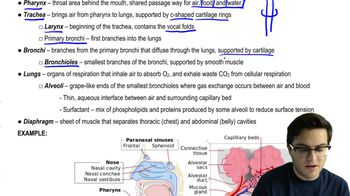
Gas exchange principle
Gases diffuse from higher to lower partial pressure across thin, moist respiratory surfaces.
Why aquatic organisms have efficient gas exchange surfaces
Gills provide large surface area and use countercurrent exchange to maximize oxygen uptake.
Terrestrial adaptations for breathing air
Insects use tracheal systems; vertebrates use lungs with branching bronchioles and alveoli.
Difference between positive and negative pressure breathing
Amphibians push air in by shrinking oral cavity (positive); mammals pull air in by expanding thoracic cavity (negative).
Why hemoglobin is necessary
Oxygen has low solubility in water; hemoglobin binds oxygen to reduce required cardiac output.
 Back
Back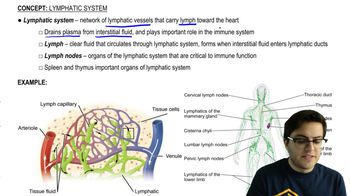
 02:15
02:15