Skip to main content
General Biology
My Course
Learn
Exam Prep
AI Tutor
Study Guides
Textbook Solutions
Flashcards
Explore
Try the app
My Course
Learn
Exam Prep
AI Tutor
Study Guides
Textbook Solutions
Flashcards
Explore
Try the app
Back
Community Ecology and Species Interactions
You can tap to flip the card.
Survivorship curve type for population with rapid decline in early life
You can tap to flip the card.
👆
Survivorship curve type for population with rapid decline in early life
Type III survivorship curve, characterized by high mortality early in life and low parental care.
Track progress
Control buttons has been changed to "navigation" mode.
1/31
Recommended videos
02:03
Introduction to Community Ecology
2120
views
30
rank
Terms in this set (31)
Hide definitions
Survivorship curve type for population with rapid decline in early life
Type III survivorship curve, characterized by high mortality early in life and low parental care.
Definition of a biological community
A group of populations of different species living close enough to interact.
Key factors influencing community structure
Number, composition, and relative abundance of species within a community.
Types of interspecific interactions
Competitive (-/-), exploitative (+/-), mutualism (+/+), commensalism (+/0), parasitism, predation, herbivory.
Competitive exclusion principle
Local elimination of an inferior competitor when two species use the same limited resources.
Character displacement
Divergence of species traits in sympatric populations to reduce competition.
Parasitism
One species (parasite) lives on or in another (host), using its resources to survive and reproduce.
Difference between endoparasites and ectoparasites
Endoparasites live inside the host; ectoparasites live on the host's surface.
Predation adaptations in predators
Acute senses, claws, fangs, venom, speed, camouflage to catch and subdue prey.
Behavioral prey defenses
Hiding, fleeing, forming herds or schools to avoid predators.
Morphological and physiological prey defenses
Mechanical defenses like spines and chemical defenses like toxins.
Aposematic coloration
Bright warning colors in toxic animals to deter predators.
Cryptic coloration
Camouflage that makes prey difficult to detect in their environment.
Batesian mimicry
A harmless species mimics a harmful one to avoid predation.
Müllerian mimicry
Two or more unpalatable species resemble each other, reinforcing predator avoidance.
Herbivory
Interaction where herbivores eat parts of plants or algae, usually harming but not killing them.
Plant defenses against herbivory
Mechanical defenses like thorns and chemical defenses like toxins or bad taste.
Mutualism
Interaction where both species benefit, e.g., mycorrhizae and plants.
Commensalism
One species benefits while the other is neither harmed nor helped.
Ecological niche
Abiotic and biotic space used by a species, including its role and habitat.
Fundamental vs. realized niche
Fundamental niche is all possible habitats a species can use; realized niche is where it actually lives.
Resource partitioning
Differentiation of niches that allows similar species to coexist.
Species richness vs. relative abundance
Richness is the number of species; relative abundance is the proportion each species represents.
Food chain vs. food web
Food chain is a linear transfer of energy; food web is interconnected food chains.
Keystone species
Species that exert strong control on a community by their ecological role.
Bottom-up control
Abundance at each trophic level limited by nutrient supply or food availability at lower levels.
Top-down control
Abundance at each trophic level controlled by consumers at higher trophic levels.
Intermediate disturbance hypothesis
Moderate levels of disturbance promote greater species diversity than high or low levels.
Primary succession
Colonization and establishment of species in a lifeless area after a disturbance.
Secondary succession
Recolonization of an area after disturbance that leaves some community members intact.
Island biogeography theory
Number of species on an island balances immigration and extinction rates, influenced by island size and distance.
 BackBack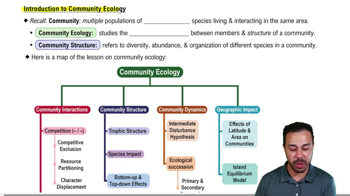
 02:03
02:03