A −/− interspecific interaction where both species are harmed by sharing limited resources. Can lead to competitive exclusion or niche partitioning.
Competitive exclusion
Gause's principle: two species with identical niches cannot coexist permanently — the better competitor will eliminate the other.
Ecological niche
The full set of biotic and abiotic resources an organism uses in its environment — its ecological role, including food, habitat, temperature range, and timing of activity.
Fundamental niche
The full range of conditions and resources a species could potentially occupy in the absence of competitors.
Realized niche
The portion of the fundamental niche a species actually occupies after competition limits it. Always smaller than or equal to the fundamental niche.
Resource partitioning
Differentiation of niches that allows similar species to coexist by using different resources in space, time, or diet. Example: Anolis lizards using different perch heights.
Character displacement
The tendency for traits to diverge more in sympatric populations of two competing species than in allopatric populations. Example: Galapagos finch beak depths diverge where species overlap.
Predation
A +/- interspecific interaction where the predator kills and eats the prey. Drives evolution of offense adaptations (venom, speed) and defense adaptations (camouflage, toxins, mimicry).
Herbivory
A +/- interaction where an herbivore eats part of a plant or alga, benefiting while harming but usually not killing the plant. Plants evolved chemical (nicotine, tannins) and structural defenses (thorns).
Parasitism
A +/- interaction where the parasite derives nourishment from the host, harming it. Endoparasites live inside (tapeworms); ectoparasites live outside (ticks, lice).
Mutualism
A +/+ interaction that benefits individuals of both species. Example: acacia trees provide food and shelter to ants that protect the tree from herbivores and competitors.
Commensalism
A +/0 interaction that benefits one species while leaving the other unaffected. Example: cattle egrets following buffalo to catch insects flushed out of the grass.
Aposematic coloration
Bright warning coloration in prey signaling toxicity or unpalatability. Example: poison dart frogs' vivid colors.
Cryptic coloration
Camouflage that makes prey difficult to see against their background. Example: canyon tree frog blending into rocks.
Batesian mimicry
A harmless or palatable species mimics a harmful or unpalatable species. Only the mimic is safe and free-rides on the harmful model's reputation. Example: hawkmoth larva mimics a venomous snake.
Mullerian mimicry
Two or more genuinely harmful or unpalatable species resemble each other, causing predators to learn faster to avoid their shared warning pattern. Example: yellow jacket and cuckoo bee.
Species diversity
A measure of community composition including species richness (number of species) and relative abundance (evenness of individuals among species).
Species richness
The number of different species in a community or ecosystem. One component of species diversity.
Relative abundance
The proportion of each species among all individuals in a community. Dominance by one species lowers diversity even if richness is the same.
Shannon diversity index (H)
A mathematical index of community diversity accounting for species richness and relative abundance. Higher \(H\) means more diversity.
Food chain
A linear sequence showing transfer of chemical energy from one trophic level to the next through feeding relationships.
Food web
A network of interconnected food chains in a community. More realistic because species eat at multiple trophic levels and are eaten by multiple species.
Trophic level
The feeding position an organism occupies in a food chain: primary producer, primary consumer, secondary consumer, tertiary consumer, etc.
Trophic efficiency
The percentage of production transferred from one trophic level to the next, averaging ~10%. The other 90% is lost to respiration, feces, and uneaten biomass.
Energetic hypothesis
Explains why food chains are short (~4-5 links): energy transfer is inefficient, so too little energy remains at higher levels to support another trophic level.
Keystone species
A species with a disproportionately large effect on community structure through its ecological role, not necessarily abundant. Example: Pisaster sea star controls mussels.
Foundation species
A species with strong effects on community structure due to large size or high abundance, providing habitat or food. Example: American chestnut, kelp, corals.
Ecosystem engineer
A species that creates, modifies, or destroys habitat affecting other species and community structure. Example: beavers building dams.
Bottom-up control
Community organization where abundance at each trophic level is limited by food or nutrients availability at lower levels.
Top-down control
Community organization where predators limit herbivores, releasing plants or algae, creating a trophic cascade of alternating +/- effects down the food web.
Trophic cascade
Indirect effects through a food web when a top predator is added or removed, causing alternating increases and decreases at each lower trophic level.
Disturbance (ecological)
An event like storm, fire, or human activity that changes a community by removing organisms or altering resource availability.
Invasive species
A non-native species introduced to a new region, free from natural predators and competitors, that spreads and disrupts native communities.
 Back
Back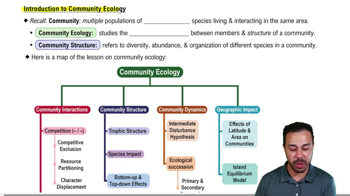
 02:03
02:03