 Back
BackDarwinian Evolution and Evidence of Natural Selection
 07:48
07:48
Terms in this set (20)
Descent with modification is Darwin's phrase describing evolution as the process where species change over time, sharing a common ancestor but diverging through adaptations.
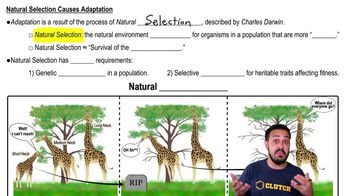
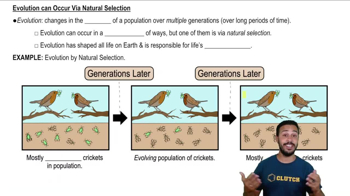
Natural selection is the process where individuals with favorable inherited traits survive and reproduce more successfully, increasing those traits in the population over generations.
Artificial selection is human-driven breeding where individuals with desired traits are selected to produce offspring with those traits.
Lamarck proposed that species evolve through use and disuse of body parts and inheritance of acquired characteristics, a mechanism unsupported by evidence.
Geologists Hutton and Lyell proposed slow, steady geological changes shaping Earth, influencing Darwin's view of an old Earth and gradual biological change.
Fossils are remains of past organisms found in sedimentary rock layers called strata, with older fossils in deeper layers.
Darwin observed species variation and fossils during his voyage, noting species on the Galápagos resembled South American species, suggesting colonization and speciation.
1) Populations vary in inherited traits. 2) More offspring are produced than can survive, leading to competition.
1) Individuals with favorable traits survive and reproduce more. 2) This leads to accumulation of favorable traits in populations over time.
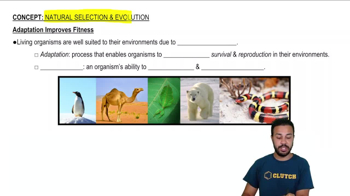
Adaptation is a heritable trait that increases an organism's survival and reproductive success in a specific environment.
Evolution occurs in populations over generations, not in individuals during their lifetime.
Four main types: direct observations, homology, fossil record, and biogeography.
Homology refers to similarity due to common ancestry, seen in anatomical structures and molecular sequences.
Remnants of features that had important functions in ancestors but are reduced or nonfunctional in descendants.
Independent evolution of similar traits in distantly related groups due to similar environmental pressures, producing analogous structures.
Documents extinction, origin of new groups, and transitional forms showing evolutionary change over time.
Study of species distribution across geographic areas, supporting evolution through patterns like endemic species on islands.
Soapberry bugs evolved beak length to match the size of native or introduced fruit seeds, demonstrating rapid adaptation.
Bacteria like MRSA evolve resistance to antibiotics through natural selection, surviving drug exposure and reproducing resistant strains.
Mutations are changes in DNA sequences that provide genetic variation for natural selection to act upon.