Skip to main content
General Biology
My Course
Learn
Exam Prep
AI Tutor
Study Guides
Textbook Solutions
Flashcards
Explore
Try the app
My Course
Learn
Exam Prep
AI Tutor
Study Guides
Textbook Solutions
Flashcards
Explore
Try the app
Back
Divisão celular
You can tap to flip the card.
What is cell division?
You can tap to flip the card.
👆
What is cell division?
Cell division is the process by which a cell divides to form two or more daughter cells.
Track progress
Control buttons has been changed to "navigation" mode.
1/21
Recommended videos
04:45
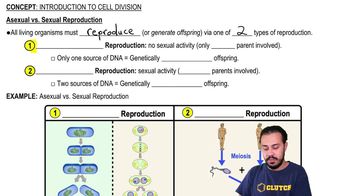
Asexual vs. Sexual Reproduction
18600
views
391
rank
3
comments
09:40
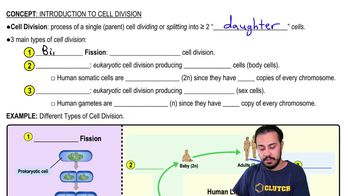
Introduction to Cell Division
28250
views
638
rank
1
comments
03:19
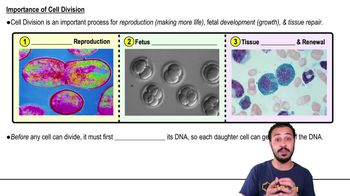
Importance of Cell Division
17806
views
574
rank
1
comments
Terms in this set (21)
Hide definitions
What is cell division?
Cell division is the process by which a cell divides to form two or more daughter cells.
What are the two main types of cell division?
The two main types are
mitosis
and
meiosis
.
What occurs during mitosis?
Mitosis occurs in somatic cells, producing 2 genetically identical daughter cells with the chromosome number maintained (2n > 2n).
What is the function of mitosis?
Mitosis functions in growth, tissue repair, and asexual reproduction.
What occurs during meiosis?
Meiosis occurs in germ cells, producing 4 genetically different daughter cells with chromosome number halved (2n > n).
What is the importance of meiosis?
Meiosis is important for gamete formation and increasing genetic variability.
What are the main phases of the cell cycle?
The cell cycle includes
interphase
(G1, S, G2 phases) and the
mitotic phase
(mitosis and cytokinesis).
What happens during interphase?
During interphase, the cell grows (G1), duplicates DNA (S), and prepares for mitosis (G2).
List the four main stages of mitosis.
The four main stages are
prophase
,
metaphase
,
anaphase
, and
telophase
.
What occurs during prophase in mitosis?
Chromatin condenses into chromosomes, spindle fibers form, and the nuclear envelope breaks down.
What happens during metaphase in mitosis?
Chromosomes align at the cell's equatorial plate, attached to spindle fibers.
Describe anaphase in mitosis.
Sister chromatids separate and move toward opposite poles of the cell.
What occurs during telophase in mitosis?
Chromosomes decondense, nuclear envelopes reform, and the spindle fibers disappear.
What is cytokinesis?
Cytokinesis is the division of the cytoplasm, resulting in two separate daughter cells.
What is the difference between meiosis I and meiosis II?
Meiosis I is a reductional division (2n > n) separating homologous chromosomes; meiosis II is equational (n > n) separating sister chromatids.
What happens during prophase I of meiosis?
Homologous chromosomes pair up and crossing-over occurs, increasing genetic variation.
How many cells result from meiosis and are they genetically identical?
Meiosis produces 4 haploid cells that are genetically different from each other.
How many chromosomes does each daughter cell have after meiosis if the original cell is 2n=46?
Each daughter cell has 23 chromosomes (haploid, n=23).
What is a chromatid?
A chromatid is one of two identical copies of a duplicated chromosome, joined at the centromere.
What is the role of crossing-over in meiosis?
Crossing-over exchanges genetic material between homologous chromosomes, increasing genetic diversity.
Frente
Verso
 Back
 04:45

 Back