Skip to main content
General Biology
My Course
Learn
Exam Prep
AI Tutor
Study Guides
Textbook Solutions
Flashcards
Explore
Try the app
My Course
Learn
Exam Prep
AI Tutor
Study Guides
Textbook Solutions
Flashcards
Explore
Try the app
Back
DNA Replication and Chromosome Structure in General Biology
You can tap to flip the card.
What is the basic principle of DNA replication?
You can tap to flip the card.
👆
What is the basic principle of DNA replication?
Each DNA strand acts as a template for building a new complementary strand based on base-pairing rules.
Track progress
Control buttons has been changed to "navigation" mode.
1/22
Recommended videos
05:10
Unwinding the DNA: Topoisomerase, Helicase & SSBs
17588
views
208
rank
04:47
Components of DNA Replication
20068
views
283
rank
03:33
Origin of Replication
18509
views
235
rank
Terms in this set (22)
Hide definitions
What is the basic principle of DNA replication?
Each DNA strand acts as a template for building a new complementary strand based on base-pairing rules.
What model does DNA replication follow?
DNA replication follows the
semi-conservative model
, where each daughter molecule has one parental and one new strand.
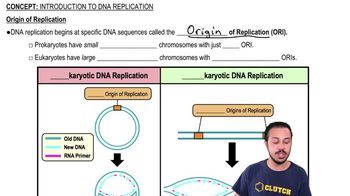
Where does DNA replication begin?
Replication begins at specific sites called
origins of replication
, where the two DNA strands separate to form a replication bubble.
What is a replication fork?
A
replication fork
is a Y-shaped region at the end of a replication bubble where new DNA strands are elongating.
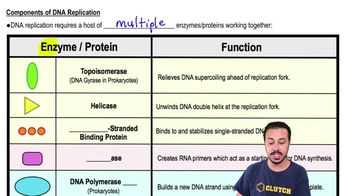
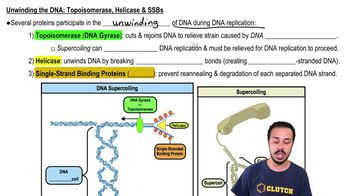
What role do helicases play in DNA replication?
Helicases untwist the double helix at the replication forks, separating the two DNA strands.
What is the function of single-strand binding proteins?
They bind to and stabilize single-stranded DNA to prevent it from reannealing or being degraded.
How does topoisomerase assist DNA replication?
Topoisomerase corrects overwinding ahead of replication forks by breaking, swiveling, and rejoining DNA strands.
What is the role of primase in DNA replication?
Primase synthesizes a short RNA primer (5–10 nucleotides) that provides a starting point for DNA polymerase.
Why can't DNA polymerases initiate DNA synthesis on their own?
DNA polymerases can only add nucleotides to an existing 3′ end; they require a primer to start synthesis.
In which direction do DNA polymerases add nucleotides?
DNA polymerases add nucleotides only to the free 3′ end, so DNA synthesis proceeds in the 5′ to 3′ direction.
What is the difference between the leading and lagging strands?
The leading strand is synthesized continuously toward the replication fork; the lagging strand is synthesized away from the fork in Okazaki fragments.
What are Okazaki fragments?
Short DNA segments synthesized discontinuously on the lagging strand, later joined by DNA ligase.
How fast is DNA elongation in bacteria and human cells?
About 500 nucleotides per second in bacteria and 50 nucleotides per second in human cells.
What is the role of DNA ligase in replication?
DNA ligase joins Okazaki fragments on the lagging strand to create a continuous DNA strand.
How do DNA polymerases ensure replication accuracy?
DNA polymerases proofread newly made DNA, replacing incorrect nucleotides to reduce errors.
What is mismatch repair in DNA replication?
Repair enzymes correct errors in base pairing that escape proofreading.
What is nucleotide excision repair?
A nuclease cuts out damaged DNA segments, which are then replaced by DNA polymerase and sealed by DNA ligase.
Why are mutations important in evolution?
Mutations create genetic variation, which is the raw material for natural selection.
How is bacterial DNA organized?
Bacterial chromosomes are double-stranded, circular DNA molecules that are supercoiled and located in the nucleoid region.
How is eukaryotic DNA organized in chromosomes?
Eukaryotic chromosomes have linear DNA molecules tightly packed with proteins into chromatin.
What is chromatin?
Chromatin is the complex of DNA and proteins that condenses to form chromosomes in the nucleus.
How do chromosomes fit inside the nucleus?
Chromosomes are packed through an elaborate multilevel system of folding and coiling.
 BackBack
 05:10