 Back
BackDNA Replication, Transcription, Translation and Central Dogma
 05:45
05:45
Terms in this set (19)
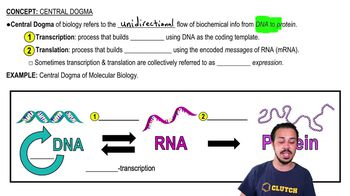
The flow of genetic information from DNA to RNA to protein.
In any species, the amount of Adenine (A) equals Thymine (T), and the amount of Guanine (G) equals Cytosine (C).
Purines (A and G) pair with pyrimidines (T and C) to maintain consistent DNA width: A-T and G-C pairs.
DNA has Thymine (T), RNA has Uracil (U) instead of thymine.
DNA is a double helix with a sugar-phosphate backbone and nitrogenous bases paired by hydrogen bonds.
Replication is semiconservative: each daughter DNA molecule has one parental and one new strand.
Specific sites where DNA strands separate to start replication; eukaryotes have multiple origins, prokaryotes usually one.
The replication bubble is the unwound region; replication forks are the Y-shaped regions where new DNA strands elongate.
Helicase unwinds DNA, Primase makes RNA primers, DNA polymerase synthesizes new DNA, SSB proteins stabilize strands.
Leading strand is synthesized continuously; lagging strand is synthesized discontinuously as Okazaki fragments.
DNA ligase joins Okazaki fragments by forming phosphodiester bonds to complete lagging strand synthesis.
DNA is transcribed into pre-mRNA, which is processed into mature mRNA by capping, polyadenylation, and splicing.
Introns are removed and exons are joined to form mature mRNA; splicing is catalyzed by spliceosomes.
Introns allow alternative splicing, increasing protein diversity and have evolutionary significance.
Translation has three stages: initiation, elongation, and termination.
tRNA carries specific amino acids and has an anticodon that base-pairs with mRNA codons.
The genetic code is a dictionary of codons specifying amino acids; it is nearly universal and redundant.
Occurs when a stop codon reaches the ribosome's A site; a release factor promotes polypeptide release.
Polypeptides often undergo modifications and are targeted to specific cellular locations to become functional proteins.