 Back
BackEcology Basics - General Biology

 05:01
05:01
Terms in this set (31)
Ecology is the study of organisms and their interactions with each other and their environment.
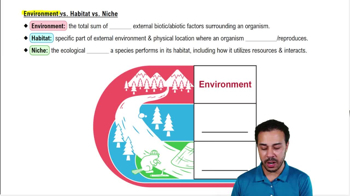
A habitat is the specific environment or 'home' where a species lives.
A population is all individuals of a single species living in a specific area.
A community is all the populations of different species living together in one area at the same time.
An ecosystem includes all living communities and the non-living (abiotic) factors in an area.
The biosphere is the sum of all ecosystems on Earth, including land, water, and air.
Biotic factors are living things like plants and animals; abiotic factors are non-living things like water, sunlight, and temperature.
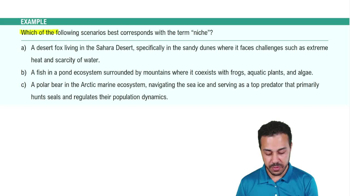
A niche is the specific role or occupation an organism has in its ecosystem, including how it obtains resources.
A habitat is where a species lives; a niche is the role it plays in that environment.
It leads to competition, which can result in one species being eliminated.
Intraspecific competition is competition between organisms of the same species, influenced by population density and resources.
Interspecific competition is competition between different species, often ending with one species outcompeting the other.
Population size is limited by resources (like oxygen, water, nutrients) and competition among organisms.
A limiting factor is any biotic or abiotic element that restricts population growth.
Examples include dissolved oxygen, sunlight availability, and extreme temperatures.
Predators reduce prey populations; if prey decline too much, predator numbers also drop, creating cyclical population changes.
Carrying capacity is the maximum population size an ecosystem can support based on available resources and interactions.
1. Constant energy source
2. Organisms to use energy
3. Nutrient recycling between organisms
Energy flows one way: from the sun to producers, then consumers, and finally decomposers.
Producers make their own food (autotrophs). Consumers eat other organisms (heterotrophs). Decomposers break down dead matter and recycle nutrients.
Herbivores (eat plants), carnivores (eat animals), omnivores (eat both), and scavengers (eat dead animals).
A food chain shows the linear flow of energy through different trophic levels in an ecosystem.
A food web is a complex network of feeding relationships showing multiple food chains interconnected.
It shows energy transfer between trophic levels; only about 10% of energy passes to the next level, with energy lost as heat.
Close interactions between two species where at least one benefits; includes mutualism, parasitism, and commensalism.
Both species benefit; e.g., bees get nectar and pollinate flowers.
One benefits (parasite), the other is harmed (host); e.g., ticks feeding on dogs.
One benefits, the other is unaffected; e.g., barnacles on whales.
Recycling of water, oxygen, carbon, and nitrogen sustains ecosystems by reusing essential materials.
Gradual changes in an ecosystem over time, leading to a stable climax community.
Primary succession starts on bare rock with no soil; secondary succession occurs where an ecosystem was disturbed but soil remains.