 Back
BackEvolution and Natural Selection in General Biology
 07:48
07:48
Terms in this set (20)
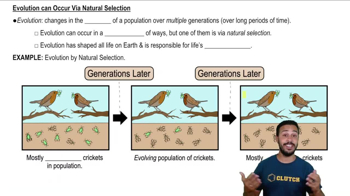
Biological evolution is the heritable change in one or more characteristics of a population or species from one generation to the next.
Microevolution involves small-scale changes in a single gene in a population over time, while macroevolution involves larger-scale changes such as the formation of new species or groups of species.
1. Perpetual change
2. Common descent
3. Multiplication of species
4. Gradualism
5. Natural selection
1. Variation in traits
2. Heredity of traits
3. Differential reproductive success
The drought reduced small seeds, causing small-beaked birds to struggle and suffer heavy mortality, demonstrating natural selection favoring larger beak sizes.
Adaptive radiation is the production of several ecologically diverse species from a common ancestral species, typically occurring within a short geological time interval.
Alfred Russel Wallace, a naturalist working in the Amazon and Southeast Asia, independently conceived natural selection around 1848.
Malthus' essay on population growth showed populations increase exponentially while food supply grows linearly, implying competition and limited resources, inspiring Darwin's natural selection concept.
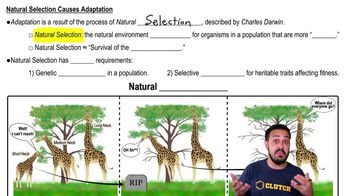
Variation in heritable traits, more offspring than can survive, limited resources causing competition, and differential survival and reproduction based on traits.
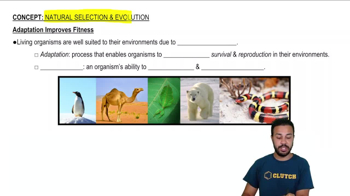
Natural selection leads to adaptations, traits that increase an organism's survival and reproductive success in its environment.
Fossil record, biogeography, observations of natural and artificial selection, homologies (anatomical, developmental, molecular).
A fossil is a trace of a past organism usually preserved in sedimentary rock; its age is estimated by the depth of the rock layer (strata) where it is found.
A transitional form is an intermediate fossil showing traits between an ancestral form and its descendant, illustrating gradual evolutionary change.
Biogeography studies the spatial distribution of species, showing how isolated continents and islands have many endemic species due to evolutionary history.
Artificial selection is selective breeding by humans choosing parents to produce desired traits, made possible by existing genetic variation.
Homology is the fundamental similarity in traits due to descent from a common ancestor, seen in anatomical, developmental, and molecular features.
Convergent evolution occurs when two species from different lineages develop similar traits because they occupy similar environments.
Genetic variation arises from random mutations, exon shuffling, sexual reproduction (reshuffling genes), and horizontal gene transfer.
All living species use DNA to store information, and closely related species have more similar DNA sequences than distantly related species.
Whales retain hind limb bones as vestigial structures because their terrestrial ancestors had legs, showing evolutionary descent.