 Back
BackEvolution: How Populations Evolve & Tracing Evolutionary History
 07:48
07:48
Terms in this set (25)
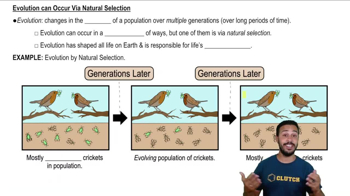
Microevolution is the change in allele frequencies in a population over generations.
Genetic variation refers to differences in DNA sequences among individuals in a population.
A mutation is a change in the nucleotide sequence of DNA that can introduce new alleles.
Gene flow is the transfer of alleles between populations due to migration.
Genetic drift is random changes in allele frequencies, especially significant in small populations.
The founder effect occurs when a new population is started by a few individuals, reducing genetic variation.
The bottleneck effect is a sharp reduction in population size that reduces genetic diversity.
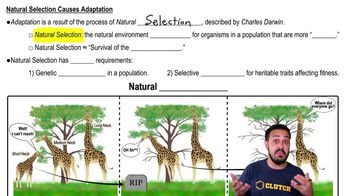
Natural selection is the process where individuals with favorable traits survive and reproduce more.
The Hardy-Weinberg equilibrium describes a non-evolving population where allele frequencies remain constant.
No mutation, random mating, no natural selection, large population size, and no gene flow.
Speciation is the process by which new species arise from existing ones.
Phylogeny is the evolutionary history and relationships among species or groups.
Homologous structures are anatomical features shared by species due to common ancestry.
Analogous structures have similar functions but evolved independently, not from a common ancestor.
Molecular clocks use mutation rates in DNA to estimate the time since two species diverged.
Cladistics is a method of classifying species based on common ancestry using shared derived traits.
A derived trait is a characteristic that evolved in the lineage leading up to a clade and sets it apart.
An ancestral trait is a characteristic inherited from a distant common ancestor.
Adaptive radiation is the rapid evolution of many species from a common ancestor to fill diverse niches.
A population is a group of individuals of the same species living in the same area.
Allele frequency is the proportion of a specific allele among all alleles in a population.
The gene pool is the total collection of alleles in a population.
Sexual selection is natural selection for mating success, often leading to traits that improve reproductive success.
A phylogenetic tree is a diagram showing evolutionary relationships among species.
A clade is a group of organisms that includes an ancestor and all its descendants.