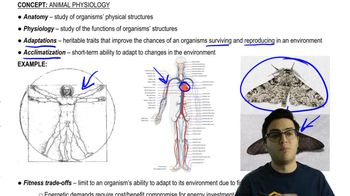
What is the difference between anatomy and physiology?
Anatomy is the study of physical structures or form, while physiology is the study of the function of those structures in an organism.
Define adaptation and acclimatization in animals.
Adaptation is a heritable trait that improves survival or reproduction. Acclimatization is a short-term, reversible phenotypic change in response to the environment.
What are the four major tissue types in animals?
Epithelial, connective, muscle, and nervous tissues.
Describe the main function of epithelial tissue.
Epithelial tissue forms sheets of closely packed cells that cover body surfaces and line organs and cavities.
What characterizes connective tissue?
Connective tissue consists of cells scattered in an extracellular matrix, often forming a web of fibers.
What enables muscle tissue to contract?
Muscle tissue contains filaments of actin and myosin that enable contraction.
What is the role of nervous tissue?
Nervous tissue receives, processes, and transmits information.
What is homeostasis?
Homeostasis is the maintenance of a steady internal state or balance despite external changes.
What are the two approaches animals use to maintain homeostasis?
Regulators maintain internal conditions despite external changes; conformers allow internal conditions to vary with the environment.
What are the three components of a homeostatic system?
1. Sensor: detects internal or external conditions. 2. Integrator: evaluates info and compares to set point. 3. Effector: restores internal conditions.
Define negative feedback in physiological regulation.
Negative feedback reduces the output or activity to return a system to its set point, maintaining stability.
What is thermoregulation?
Thermoregulation is the maintenance of internal body temperature within a normal range.
Compare endotherms and ectotherms.
Endotherms generate heat metabolically (birds, mammals). Ectotherms gain heat from external sources (invertebrates, fishes, reptiles).
What is vasodilation and its function?
Vasodilation is the widening of blood vessels to promote heat loss.
What is vasoconstriction and its function?
Vasoconstriction is the narrowing of blood vessels to reduce heat loss.
Explain countercurrent heat exchange.
Countercurrent exchange transfers heat between fluids flowing in opposite directions, efficiently reducing heat loss.
Name the four physical processes of heat exchange in organisms.
Radiation, evaporation, convection, and conduction.
What is the resting membrane potential in neurons?
The resting potential is the voltage difference across the neuron's membrane when not sending signals, typically around -70mV.
How is the resting membrane potential maintained?
By Na+/K+ pumps using ATP and more leaky K+ channels than Na+ channels, creating ion gradients.
What triggers an action potential in a neuron?
When depolarization reaches a threshold (~-55mV), voltage-gated Na+ channels open, causing an all-or-nothing action potential.
What is saltatory conduction?
In myelinated axons, action potentials jump between nodes of Ranvier, speeding conduction.
How do chemical synapses transmit signals?
Action potential causes Ca2+ influx, triggering neurotransmitter release, which binds postsynaptic receptors to change membrane potential.
Differentiate EPSP and IPSP.
EPSP depolarizes the postsynaptic membrane, increasing AP likelihood; IPSP hyperpolarizes it, decreasing AP likelihood.
What is synaptic summation?
The combination of multiple postsynaptic potentials; temporal summation is rapid successive EPSPs, spatial summation is simultaneous EPSPs from different synapses.
Name major neurotransmitter types and their roles.
 Back
Back
 03:16
03:16