What are the main components of thick and thin filaments in muscle fibers?
Thick filaments are made of myosin molecules with heads and tails, while thin filaments consist of two strands of polymerized actin coiled together.
What is the hierarchical organization of skeletal muscle from largest to smallest units?
Muscle → bundle of muscle fibers → single muscle fiber (cell) → myofibrils → sarcomeres.
What is a sarcomere and why is it important?
A sarcomere is the contractile unit of a myofibril, where thick and thin filaments partially overlap to enable muscle contraction.
Describe the sliding filament model of muscle contraction.
Thick and thin filaments slide past each other longitudinally, shortening the sarcomere and muscle, but the filaments themselves do not change length.
How do myosin heads contribute to muscle contraction?
Myosin heads bind to actin, undergo conformational changes powered by ATP hydrolysis, and pull thin filaments toward the sarcomere center.
What role does ATP play in muscle contraction?
ATP binds to myosin heads, enabling detachment from actin and providing energy for the power stroke during contraction.
How is muscle contraction regulated by calcium ions?
Ca²⁺ binds to the troponin complex, causing tropomyosin to move and expose myosin-binding sites on actin, allowing contraction.
What is the function of the sarcoplasmic reticulum in muscle fibers?
The sarcoplasmic reticulum stores and releases Ca²⁺ ions to regulate muscle contraction.
What is the neuromuscular junction and its role in muscle contraction?
The neuromuscular junction is the synapse where a motor neuron releases acetylcholine to trigger an action potential in the muscle fiber.
Outline the sequence from motor neuron action potential to muscle contraction.
Motor neuron AP → acetylcholine release → muscle fiber depolarization → Ca²⁺ release from sarcoplasmic reticulum → Ca²⁺ binds troponin → contraction.
What is a motor unit in muscle control?
A motor unit consists of a single motor neuron and all the muscle fibers it controls, contracting together in an all-or-nothing response.
Define twitch, summation, and tetanus in muscle contraction.
Twitch: single contraction from one AP; Summation: increased force from multiple APs before relaxation; Tetanus: sustained contraction from rapid APs.
How does recruitment affect muscle contraction strength?
Recruitment increases contraction strength by activating more motor units and muscle fibers.
Compare fast-twitch and slow-twitch muscle fibers.
Fast-twitch fibers contract quickly, fatigue fast, and rely on glycolysis or aerobic respiration; slow-twitch fibers contract slowly, resist fatigue, and rely on aerobic respiration.
What is the role of myoglobin in muscle fibers?
Myoglobin stores oxygen in muscle fibers, supporting aerobic respiration, especially in slow-twitch oxidative fibers.
Describe the difference between oxidative and glycolytic muscle fibers.
Oxidative fibers use aerobic respiration, have many mitochondria and myoglobin; glycolytic fibers rely on glycolysis, have fewer mitochondria, and fatigue faster.
What are the characteristics of cardiac and smooth muscle compared to skeletal muscle?
Cardiac muscle is striated, involuntary, and has pacemaker cells; smooth muscle is non-striated, involuntary, and found in hollow organs.
How do antagonistic muscle pairs enable movement?
One muscle contracts while the opposing muscle relaxes, allowing coordinated movement around joints.
What is excitation-contraction coupling in muscle fibers?
The process where an action potential triggers Ca²⁺ release from the sarcoplasmic reticulum, leading to muscle contraction.
How is calcium removed to allow muscle relaxation?
Ca²⁺ is actively transported back into the sarcoplasmic reticulum, allowing tropomyosin to block myosin-binding sites and muscle relaxation.
 Back
Back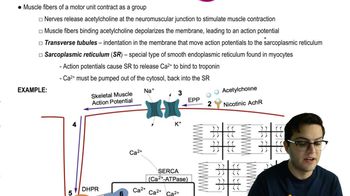
 03:14
03:14