 Back
BackFinal exam study
 02:09
02:09

Terms in this set (22)
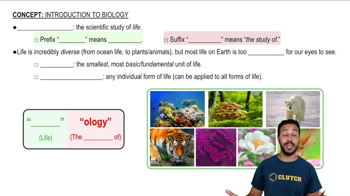
Made of cells, use energy, respond to environment, grow and develop, reproduce, maintain homeostasis, evolve over generations.
Observation, Question, Hypothesis, Experiment, Analyze, Conclusion, Repeat.
Carbon, Hydrogen, Oxygen, Nitrogen (CHON).
Polar molecule, good at dissolving things, cohesion, adhesion, sticks to other things, regulates temperature.
Carbohydrates: sugars, energy source. Lipids: fats, oils, store energy, make membranes. Proteins: carry out most functions.
DNA and RNA, carry genetic information.
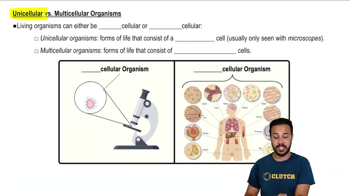
Prokaryotes: no nucleus (bacteria, archaea). Eukaryotes: have nucleus and organelles (plants, animals, fungi, protists).
Ribosomes make proteins. Cell membrane controls what enters and exits. Plant cells have cell wall, chloroplasts, large central vacuole.
Diffusion: movement from high to low concentration. Osmosis: diffusion of water. Active transport: requires energy (ATP).
Converts glucose and oxygen into ATP, water, and carbon dioxide. Equation: \(\text{Glucose} + O_2 \rightarrow CO_2 + H_2O + ATP\)
Plants/algae use sunlight to make glucose and oxygen. Equation: \(CO_2 + H_2O + \text{sunlight} \rightarrow \text{Glucose} + O_2\)
DNA double helix with bases A, T, C, G. Genes code for traits. Chromosomes are bundles of DNA; humans have 46.
Mitosis: cell division for growth/repair (2 identical cells). Meiosis: cell division for reproduction (4 unique cells).
Changes in species over generations.
Best-adapted organisms survive and reproduce.
Fossils, DNA similarities, comparative anatomy.
Study of interactions between organisms and their environment.
Organism → Population → Community → Ecosystem → Biosphere.
Producers make their own food. Consumers eat other organisms. Decomposers break down dead matter.
Energy flows from the sun to producers to consumers to decomposers.
Bacteria, Archaea, Eukarya.
Animals, Plants, Fungi, Protists, Bacteria, Archaea.