 Back
Foundations of Biology: Key Concepts and Themes
 09:50

Terms in this set (20)
Biology is the scientific study of life, exploring questions about organisms, their development, and interactions.
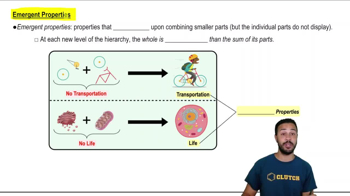
Emergent properties arise from the arrangement and interaction of parts within a system, such as how a functioning bicycle emerges only when all parts connect correctly.
Reductionism breaks complex biological systems into simpler components to make them easier to study.
Systems biology explores biological systems by analyzing interactions among their parts, combining reductionism with holistic approaches.
At each biological level, structure correlates with function, so analyzing structure helps understand how something works.
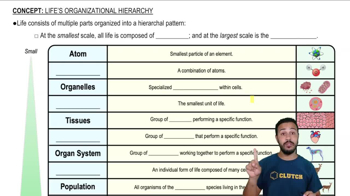
The cell is the smallest unit of life capable of performing all required activities.
Prokaryotic cells lack a nucleus and membrane-bound organelles, while eukaryotic cells have a nucleus and organelles enclosed by membranes.
DNA contains genetic material organized into genes, which transmit hereditary information and direct cell development.
Gene expression is the process of converting genetic information from DNA into cellular products, often using RNA as an intermediary.
Genomics studies the entire set of genes (genome) within and between species using DNA sequencing and computational tools.
Energy enters ecosystems as sunlight, is converted to chemical energy by producers, passed to consumers, and exits as heat.
Chemical elements are recycled within ecosystems through interactions among organisms and the environment.
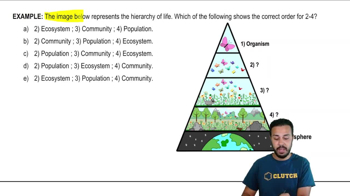
Organisms interact with each other and their environment, affecting survival, population dynamics, and evolution.
Evolution explains the unity and diversity of life through descent with modification and natural selection.
Life is classified into three domains: Bacteria, Archaea (both prokaryotes), and Eukarya (eukaryotes including plants, fungi, and animals).
Natural selection is the process where individuals with advantageous traits are more likely to survive and reproduce, driving evolution.
A hypothesis is a testable and falsifiable explanation for observations, guiding predictions and experiments.
Inductive reasoning draws general conclusions from many observations; deductive reasoning predicts specific outcomes from general premises.
A controlled experiment compares an experimental group with a control group, differing only in the variable of interest.
A theory is a broad, well-supported explanation that can generate new testable hypotheses and is supported by extensive evidence.