Skip to main content
General Biology
My Course
Learn
Exam Prep
AI Tutor
Study Guides
Textbook Solutions
Flashcards
Explore
Try the app
My Course
Learn
Exam Prep
AI Tutor
Study Guides
Textbook Solutions
Flashcards
Explore
Try the app
Back
Functional Groups in General Biology
You can tap to flip the card.
What is the structure and charge form of the Carboxyl group?
You can tap to flip the card.
👆
What is the structure and charge form of the Carboxyl group?
Structure:
R-COOH
. Ionized (charged) form: acidic, polar, hydrophilic.
Track progress
Control buttons has been changed to "navigation" mode.
1/15
Recommended videos
02:00
Functional Groups Example 1
17494
views
367
rank
1
comments
06:04
Functional Groups
25738
views
537
rank
1
comments
Terms in this set (15)
Hide definitions
What is the structure and charge form of the Carboxyl group?
Structure:
R-COOH
. Ionized (charged) form: acidic, polar, hydrophilic.
Where are Carboxyl groups commonly found?
In amino acids and bases of nucleic acids.
What is the structure and charge form of the Carbonyl group?
Structure:
R-CO-R
. Polar and hydrophilic.
Where are Carbonyl groups commonly found?
In amino acids, fatty acids, and other acids.
What is the structure and charge form of the Hydroxyl group?
Structure:
R-OH
. Polar and hydrophilic.
Where are Hydroxyl groups commonly found?
In sugars, proteins, and bases of nucleic acids.
What is the structure and charge form of the Phosphate group?
Structure:
R-PO4
. Acidic, polar, hydrophilic.
Where are Phosphate groups commonly found?
In phospholipids in membranes, DNA backbone, ATP, and play an important role in regulation.
What is the structure and charge form of the Methyl group?
Structure:
R-CH3
. Nonpolar and hydrophobic.
Where are Methyl groups commonly found?
In fatty acid chains and as an imprint on DNA for regulation.
Which functional groups are acidic and polar?
Carboxyl and Phosphate groups are acidic, polar, and hydrophilic.
Which functional groups are polar and hydrophilic but not acidic?
Carbonyl and Hydroxyl groups are polar and hydrophilic but not acidic.
Which functional group is nonpolar and hydrophobic?
The Methyl group is nonpolar and hydrophobic.
What role do Phosphate groups play in biological molecules?
They are part of phospholipids, DNA backbone, ATP, and have an important role in regulation.
How do Methyl groups affect DNA?
They act as an imprint on DNA for regulation.
 BackBack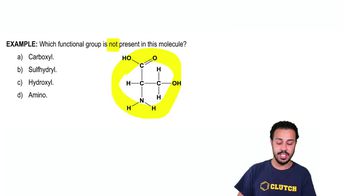
 02:00
02:00