 Back
BackFungi - General Biology

 08:59
08:59
Terms in this set (21)
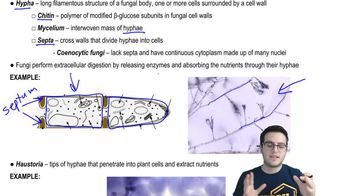
Single-celled yeasts and multicellular fungi with mycelia.
A network of woven hyphae that forms the body of multicellular fungi.
By extracellular digestion, secreting enzymes outside their bodies to break down organic matter, then absorbing the nutrients.
Lignin peroxidase catalyzes oxidation creating free radicals that split lignin polymers.
Because the six-carbon rings in lignin are difficult to metabolize and accumulate in soil.
Cellulases secreted extracellularly convert cellulose into glucose for absorption.
Fungi break down dead plant material, releasing carbon atoms back into the atmosphere and soil nutrients.
Chytrids (flagellated spores), Zygosporangia, Basidia (club-shaped), and Asci (sac-like cells).
They produce motile spores and gametes with flagella and often live in aquatic environments.
A thick-walled sexual spore-producing structure formed when hyphae fuse in zygomycetes.
Club-shaped cells where meiosis occurs, producing four haploid spores in basidiomycetes.
Sac-like cells where meiosis and mitosis occur, producing eight spores in ascomycetes.
Mutualistic fungi that form networks with plant roots to enhance nutrient and water uptake.
Ectomycorrhizal fungi form sheaths around roots; arbuscular mycorrhizal fungi penetrate root cells.
A symbiotic association between an ascomycete fungus and a photosynthetic partner like green algae or cyanobacteria.
They are sensitive to air pollution and can indicate environmental quality.
They break down tough plant materials like lignin and cellulose, recycling nutrients in ecosystems.
The fusion of cytoplasm from two parent mycelia without nuclear fusion.
The fusion of two haploid nuclei to form a diploid nucleus during sexual reproduction.
By producing spores through mitosis, often in structures like sporangia or conidia.
Fungi are more closely related to animals than to land plants based on molecular data.