Skip to main content
General Biology
My Course
Learn
Exam Prep
AI Tutor
Study Guides
Textbook Solutions
Flashcards
Explore
Try the app
My Course
Learn
Exam Prep
AI Tutor
Study Guides
Textbook Solutions
Flashcards
Explore
Try the app
Back
General Biology: A Tour of the Cell
You can tap to flip the card.
What is the primary function of a microscope?
You can tap to flip the card.
👆
What is the primary function of a microscope?
A
microscope
is an optical instrument used to visualize objects too small to be seen by the naked eye, such as cells.
Track progress
Control buttons has been changed to "navigation" mode.
1/26
Recommended videos
06:35
Microscopes
24961
views
569
rank
02:52
Types of Electron Microscopes
17909
views
357
rank
1
comments
Terms in this set (26)
Hide definitions
What is the primary function of a microscope?
A
microscope
is an optical instrument used to visualize objects too small to be seen by the naked eye, such as cells.
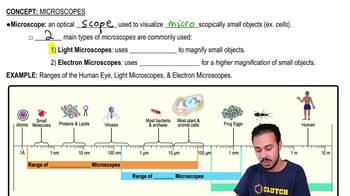
Name the two main types of microscopes and their light sources.
1)
Light microscopes
use visible light to magnify small objects. 2)
Electron microscopes
use electron beams for higher magnification.
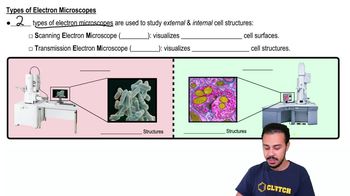
Difference between Scanning Electron Microscope (SEM) and Transmission Electron Microscope (TEM).
SEM visualizes
cell surfaces
, while TEM visualizes
internal cell structures
.
What are the two broadest categories of cells?
Prokaryotic
cells lack a nucleus;
eukaryotic
cells have a nucleus and membrane-bound organelles.
Which domains of life are prokaryotic?
Bacteria
and
Archaea
are prokaryotic domains.
Where is bacterial DNA located?
Bacterial DNA is circular and found in the
nucleoid
region, not enclosed by a membrane.
Key features of eukaryotic cells.
Eukaryotic cells have a
nucleus
, linear DNA, large (80S) ribosomes, and divide by mitosis and cytokinesis.
What is a common feature shared by all cells?
All cells contain
DNA
as genetic material, a protective membrane, and cytoplasm.
What are ribosomes and their function?
Ribosomes are molecular machines that
synthesize proteins
in all living cells.
Difference between free and bound ribosomes.
Free ribosomes float in the cytoplasm; bound ribosomes are attached to the rough ER.
What organelles produce cellular energy in eukaryotic cells?
Mitochondria
and
chloroplasts
produce cellular energy.
What is the endomembrane system?
A group of membrane-bound organelles in eukaryotic cells involved in protein secretion and cellular digestion.
Role of the nucleus in protein secretion.
The nucleus stores DNA and initiates protein synthesis by transcribing DNA into RNA.
Functions of rough and smooth endoplasmic reticulum (ER).
Rough ER has ribosomes and folds/modifies proteins; smooth ER synthesizes lipids and detoxifies drugs.
What is the Golgi apparatus and its function?
The Golgi apparatus processes, sorts, and ships proteins and lipids received from the ER.
What are lysosomes and peroxisomes?
Lysosomes contain digestive enzymes to break down debris; peroxisomes detoxify harmful compounds.
Function of the central vacuole in plant cells.
The central vacuole stores molecules, recycles materials, and maintains turgor pressure.
What is ATP and its role?
ATP (adenosine triphosphate) is a high-energy molecule that powers cellular reactions.
Describe the structure of mitochondria.
Mitochondria have two membranes: an outer membrane and a folded inner membrane (cristae), with a matrix containing DNA and enzymes.
What is photosynthesis and where does it occur?
Photosynthesis uses sunlight to synthesize sugars and occurs in chloroplasts of plant cells.
Describe the structure of chloroplasts.
Chloroplasts have two membranes, thylakoid sacs stacked into grana, and a stroma containing DNA and enzymes.
What does the endosymbiotic theory propose?
Mitochondria and chloroplasts originated from free-living bacteria engulfed by ancestral eukaryotic cells.
Three major components of the cytoskeleton.
Microfilaments (actin), intermediate filaments, and microtubules provide structure, transport, and movement.
Difference between cilia and flagella.
Cilia are short, numerous hair-like structures that move like oars; flagella are longer, whip-like tails for movement.
Types of cell junctions in animal cells.
Tight junctions, desmosomes, and gap junctions link adjacent animal cells.
What are plasmodesmata?
Plasmodesmata are channels that connect the cytoplasm of adjacent plant cells.
 BackBack
 06:35