Animals are monophyletic, originating from a common ancestor, characterized by movement under their own power and ingestion of food.
What is the significance of gene expression in multicellular animals?
Different cell types exist due to gene expression, allowing specialization and coordination within multicellular animals.
What are the general characteristics of animals?
Animals have tissues, show bilateral symmetry, exhibit cephalization (concentration of sensory organs at the head), and have a central nervous system.
Define biodiversity.
Biodiversity is the variety and variability of life on Earth, characterized by species richness, evenness, and genetic variation.
What is alpha diversity?
Alpha diversity measures the number of species in a given area or ecosystem; it is a simple, quick measure of species richness.
What does species evenness measure?
Species evenness measures the relative abundance of different species in a community, indicating how evenly individuals are distributed among species.
What is gamma diversity?
Gamma diversity quantifies the total number of species across multiple habitats or ecosystems.
What is phylogenetic diversity?
Phylogenetic diversity measures how much evolutionary history is represented in a community, based on the length of branches on a phylogenetic tree.
What is functional diversity?
Functional diversity measures the variety of ecological roles, traits, and functions of organisms within a community.
What major evolutionary events shaped life on Earth?
Key events include the origin of life (~3.5 bya), eukaryotes, multicellularity, land colonization, vertebrates, dinosaurs, mammals, and flowering plants.
How do organisms adapt to their environment?
Organisms adapt through evolutionary processes to different environmental conditions, leading to trait variation and ecological specialization.
What is ecological opportunity in evolution?
Ecological opportunity occurs when new niches or resources become available, allowing species to diversify and adapt.
What causes mass extinctions?
Mass extinctions are caused by rapid environmental changes, habitat loss, climate change, and other factors leading to high species loss.
What is the fundamental niche of a species?
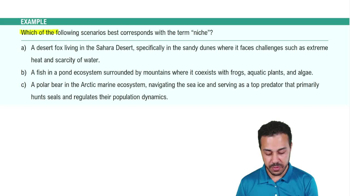
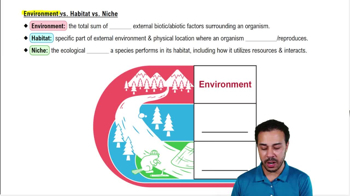
The fundamental niche is the full range of environmental conditions and resources a species can potentially use.
What is realized niche?
The realized niche is the actual conditions and resources a species occupies, often limited by competition and other factors.
How do humans impact biodiversity?
Humans cause habitat loss, species invasions, climate change, overexploitation, and fragmentation, leading to biodiversity decline.
Why are small populations vulnerable?
Small populations are vulnerable to ecological impacts, genetic drift, inbreeding depression, and random events, increasing extinction risk.
What is the extinction vortex?
The extinction vortex is a downward spiral where small population size leads to genetic and demographic problems, increasing extinction risk.
What conservation strategies help prevent extinction?
Conservation includes habitat improvement, increasing population size, restoring connectivity, captive breeding, and managing genetic diversity.
What is adaptive radiation?
Adaptive radiation is rapid diversification of a single lineage into many species exploiting different ecological niches.
What role does coevolution play in biodiversity?
Coevolution drives reciprocal evolutionary changes between interacting species, promoting diversification and specialization.
What is species richness?
Species richness is the count of different species present in a given area or community.
What is the difference between decomposers and consumers?
Decomposers break down dead organic matter, while consumers ingest and digest food.
What is cephalization?
Cephalization is the concentration of sensory organs and nervous tissue at the anterior end (head) of an animal.
What is bilateral symmetry?
Bilateral symmetry means the body can be divided into mirror-image halves along one plane.
What is the significance of sponges in animal evolution?
Sponges are simple animals with no true tissues, representing an early branch in animal evolution.
What is the importance of gene flow in conservation?
Gene flow maintains genetic diversity and reduces inbreeding, helping population resilience.
What is inbreeding depression?
Inbreeding depression is reduced fitness due to increased homozygosity and expression of deleterious alleles.
What is the role of habitat fragmentation?
Habitat fragmentation breaks ecosystems into smaller patches, reducing connectivity and increasing species vulnerability.
 Back
Back
 05:01
05:01