Skip to main content
General Biology
My Course
Learn
Exam Prep
AI Tutor
Study Guides
Textbook Solutions
Flashcards
Explore
Try the app
My Course
Learn
Exam Prep
AI Tutor
Study Guides
Textbook Solutions
Flashcards
Explore
Try the app
Back
General Biology: Animal Physiology and Development
You can tap to flip the card.
Difference in how fungal heterotrophs and animal heterotrophs obtain nutrition
You can tap to flip the card.
👆
Difference in how fungal heterotrophs and animal heterotrophs obtain nutrition
Fungal heterotrophs
absorb nutrients from dead or decaying matter, while
animal heterotrophs
ingest food and then digest it internally.
Track progress
Control buttons has been changed to "navigation" mode.
1/27
Recommended videos
Guided course
12:47
Neurotransmitters
2543
views
21
rank
Guided course
02:14
Nervous System
4559
views
76
rank
Guided course
05:33
Postsynaptic Potentials and Summation
3210
views
15
rank
Terms in this set (27)
Hide definitions
Difference in how fungal heterotrophs and animal heterotrophs obtain nutrition
Fungal heterotrophs
absorb nutrients from dead or decaying matter, while
animal heterotrophs
ingest food and then digest it internally.
Characteristics all animals have in common
Multicellularity, heterotrophy, lack of cell walls, motility at some life stage, and specialized tissues.
Most recent common ancestor to animals
Likely a colonial flagellated protist similar to choanoflagellates.
Cause of the Cambrian explosion and decline of Ediacaran biota hypotheses
Increased oxygen levels, evolution of predation, and new ecological niches.
Tissues derived from the three germ layers
Ectoderm:
skin and nervous system;
Mesoderm:
muscles and skeleton;
Endoderm:
digestive tract lining.
Difference between protostome and deuterostome cleavage
Protostomes have spiral cleavage; deuterostomes have radial cleavage.
Type of feeding used by sponges
Filter feeding using choanocytes to trap food particles.
Two body forms of cnidarians
Polyp (sessile) and medusa (free-swimming).
Function of nematocysts in cnidarians
Stinging cells used for prey capture and defense.
Structure molluscs use to feed
Radula, a tongue-like organ with rows of teeth.
Characteristic all insects share
Three-part body: head, thorax, and abdomen.
Adaptation that led to explosion of insect evolution
Evolution of wings allowing flight.
Function of echinoderm water vascular system
Locomotion, feeding, and gas exchange.
Characteristics shared by all chordates
Notochord, dorsal hollow nerve cord, pharyngeal slits, post-anal tail.
Function of pharyngeal gill slits in chordates
Filter feeding in invertebrates; respiration in aquatic vertebrates.
Advantage of jaw evolution in fish
Improved ability to grasp and process food.
Significance of the amniotic egg
Allows reproduction on land by protecting the embryo with fluid-filled membranes.
Polyspermy prevention mechanisms
Fast block via membrane depolarization; slow block via cortical reaction.
Stage when three germ layers are established
Gastrulation.
Body system responsible for coordination in vertebrates
Nervous system.
Where neurotransmitters are released
At the synaptic terminals of neurons.
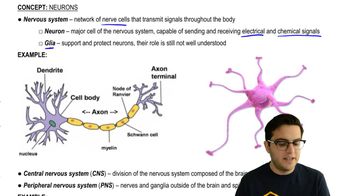
Part of neuron that transmits signal
Axon.
Part of neuron that receives signal
Dendrites.
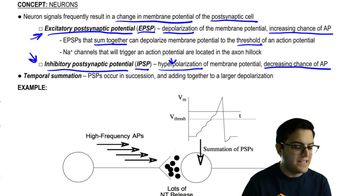
Ion concentrations at resting membrane potential
High K+ inside, high Na+ outside the cell.
Cause of Na+ and K+ concentration differences
Sodium-potassium pump actively transports ions to maintain gradients.
Movement of action potential in myelinated vs unmyelinated axons
Myelinated axons conduct faster via saltatory conduction; unmyelinated conduct slower continuously.
Phases of action potential
Rising phase (depolarization), falling phase (repolarization), undershoot (hyperpolarization), then return to resting potential.
 BackBack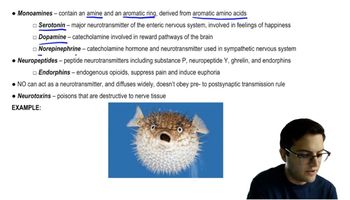
 12:47
12:47