Skip to main content
General Biology
My Course
Learn
Exam Prep
AI Tutor
Study Guides
Textbook Solutions
Flashcards
Explore
Try the app
My Course
Learn
Exam Prep
AI Tutor
Study Guides
Textbook Solutions
Flashcards
Explore
Try the app
Back
General Biology: Animal Physiology and Immunity
You can tap to flip the card.
Hypothalamus role in thermoregulation
You can tap to flip the card.
👆
Hypothalamus role in thermoregulation
The hypothalamus acts as a biological thermostat by detecting body temperature changes and activating responses to maintain a set point of ~36–38°C.
Track progress
Control buttons has been changed to "navigation" mode.
1/29
Recommended videos
Guided course
06:28
Countercurrent Exchange
2747
views
19
rank
Guided course
09:51
Thermoregulation
2753
views
19
rank
Terms in this set (29)
Hide definitions
Hypothalamus role in thermoregulation
The hypothalamus acts as a biological thermostat by detecting body temperature changes and activating responses to maintain a set point of ~36–38°C.
Negative feedback in thermoregulation
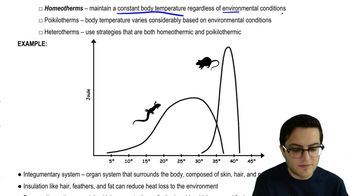
Deviations from the set point trigger responses that reverse the change to restore internal temperature homeostasis.
Response to increased body temperature
Sweat glands secrete sweat for evaporative cooling; skin blood vessels dilate (vasodilation) to increase heat loss via radiation and convection.
Response to decreased body temperature
Skin blood vessels constrict (vasoconstriction) to reduce heat loss; skeletal muscles shiver to increase metabolic heat production.
Fever as a thermoregulatory adjustment
Infection raises hypothalamic set point; body triggers heat production (shivering) and heat conservation (vasoconstriction) to reach new set point.
Osmolarity definition
Total solute concentration in a solution, measured in mol/L.
Water movement in osmosis
Water moves from hypoosmotic (lower solute) to hyperosmotic (higher solute) solutions.
Osmoregulators vs osmoconformers
Osmoregulators actively regulate internal osmolarity; osmoconformers match internal osmolarity to the environment.
Marine fish osmoregulation adaptations
Drink seawater, excrete excess salts via gills and kidneys, produce small amounts of concentrated urine to conserve water.
Freshwater fish osmoregulation adaptations
Do not drink water, excrete large volumes of dilute urine, actively uptake ions through gills and food.
Types of nitrogenous waste
Ammonia (highly toxic, aquatic animals), urea (moderate toxicity, mammals/amphibians), uric acid (low toxicity, birds/reptiles).
Four main steps of excretion
Filtration (blood pressure forces fluid out), reabsorption (useful substances returned), secretion (wastes added), excretion (urine leaves body).
Nephron functional units
Includes glomerulus, Bowman’s capsule, proximal tubule, Loop of Henle, distal tubule, and collecting duct for urine formation.
Digestive system four stages
Ingestion, digestion (mechanical and chemical), absorption, and elimination.
Difference between gastrovascular cavity and alimentary canal
Gastrovascular cavity has one opening and lower efficiency; alimentary canal has two openings and allows one-way food flow with specialization.
Functions of stomach gastric juice components
HCl denatures proteins and kills bacteria; pepsin breaks proteins into polypeptides; mucus protects stomach lining.
Small intestine adaptations for absorption
Circular folds, villi, and microvilli increase surface area to maximize nutrient absorption.
Role of liver in digestion
Produces bile to emulsify fats, regulates nutrients, and detoxifies substances.
Dental adaptations in carnivores
Large sharp incisors and canines for cutting and tearing; sharp premolars/molars for slicing flesh.
Dental adaptations in herbivores
Incisors for cutting plants, reduced canines, broad flat molars for grinding cellulose-rich plant tissue.
Mutualistic gut microbiome benefits
Microbes produce vitamins, help immune development, and prevent pathogen colonization.
Energy sources animals require
Chemical energy (carbohydrates, lipids, proteins), organic building blocks, and essential nutrients.
Hormonal control of digestion
Gastrin stimulates stomach acid; secretin triggers bicarbonate release; CCK stimulates enzyme and bile release.
Innate immunity key features
Rapid, generalized defense recognizing common pathogen patterns using barriers, phagocytes, antimicrobial peptides, and inflammation.
Adaptive immunity key features
Highly specific, slower response with memory; mediated by B cells (antibodies) and T cells (cell-mediated immunity).
Role of helper T cells
Coordinate adaptive immunity by activating B cells and cytotoxic T cells via cytokine secretion.
Clonal selection in adaptive immunity
Only lymphocytes with receptors matching an antigen are activated, proliferate, and differentiate into effector and memory cells.
Difference between active and passive immunity
Active immunity is produced by the individual's immune response and is long-lasting; passive immunity is transfer of antibodies and short-term.
Endocrine vs nervous system signaling
Endocrine uses hormones for slow, widespread, long-lasting effects; nervous system uses electrical signals for fast, targeted, short-term effects.
 BackBack
 06:28
06:28