What determines the properties of a compound such as formic acid?
A compound is made of atoms joined by bonds. The number of protons determines an atom's identity, and the electron distribution determines its ability to form bonds. A compound's properties depend on its atoms and how they are bonded.
What is an element?
An element is a substance that cannot be broken down to other substances by chemical reactions.
What is a compound?
A compound is a substance consisting of two or more elements in a fixed ratio, with properties different from those of its elements.
What are the main elements that make up living matter?
Carbon, hydrogen, oxygen, and nitrogen make up 96% of living matter; the remaining 4% includes calcium, phosphorus, potassium, and sulfur.
What subatomic particles form the atomic nucleus?
Neutrons and protons form the atomic nucleus, while electrons form a cloud of negative charge around it.
What is an atom's atomic number?
The atomic number is the number of protons in an atom's nucleus.
What is an isotope?
Isotopes are atoms of the same element that differ in the number of neutrons.
What is radiometric dating based on?
Radiometric dating measures the ratio of parent to daughter isotopes and uses the isotope's half-life to estimate the age of fossils or rocks.
What is potential energy in atoms?
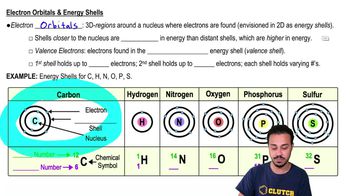
Potential energy is the energy matter possesses due to its location or structure; electrons have potential energy based on their distance from the nucleus.
What are valence electrons?
Valence electrons are the electrons in the outermost shell of an atom and determine its chemical behavior.
What is an orbital?
An orbital is a three-dimensional space where an electron is found 90% of the time; each shell contains a specific number of orbitals.
What is a covalent bond?
A covalent bond is a chemical bond where two atoms share one or more pairs of valence electrons.
What is the difference between nonpolar and polar covalent bonds?
In nonpolar covalent bonds, electrons are shared equally; in polar covalent bonds, electrons are shared unequally due to differences in electronegativity.
What is an ionic bond?
An ionic bond is the attraction between oppositely charged ions formed when atoms transfer electrons.
What are salts in chemistry?
Salts are ionic compounds formed by ionic bonds, often found as crystals, such as sodium chloride (table salt).
What is a hydrogen bond?
A hydrogen bond forms when a hydrogen atom covalently bonded to one electronegative atom is attracted to another electronegative atom.
What are Van der Waals interactions?
Van der Waals interactions are weak attractions between molecules caused by uneven electron distribution creating temporary charges.
What happens in a chemical reaction?
Chemical reactions involve making and breaking chemical bonds, converting reactants into products.
What is chemical equilibrium?
Chemical equilibrium is reached when the forward and reverse reactions occur at the same rate, keeping reactant and product concentrations constant.
What determines an atom's chemical behavior?
Electrons, especially valence electrons, form a negative cloud around the nucleus and determine an atom's chemical behavior.
 Back
Back
 02:13
02:13