 Back
BackGeneral Biology: Basic Chemistry Concepts
 02:13
02:13
Terms in this set (24)
Matter is anything that takes up space and has mass.
An element is a substance that cannot be broken down into other substances by chemical reactions.
An atom is the smallest unit of matter that retains the properties of an element.
Protons are subatomic particles with a positive charge, found in the nucleus, with a mass of about 1.7×10⁻²⁴ g.
Neutrons are neutral subatomic particles in the nucleus with a mass about 1.7×10⁻²⁴ g.
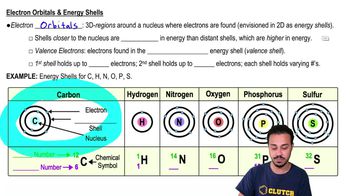
Electrons are negatively charged subatomic particles with a mass about 1/2000 that of a proton, moving around the nucleus.
The atomic number is the number of protons in an atom's nucleus, unique to each element.
Atomic mass is the total mass of an atom, averaged for isotopes weighted by abundance, and equals the mass in grams of 1 mole of the atom.
An isotope is an atomic form of an element with the same number of protons but different numbers of neutrons.
An ion is an atom or group of atoms that has gained or lost electrons, acquiring a charge.
A molecule consists of two or more atoms held together by covalent bonds.
A compound is a substance made of two or more different elements combined in a fixed ratio.
A chemical bond is an attraction between atoms due to sharing electrons or opposite charges, resulting in complete outer electron shells.
An ionic bond forms from the attraction between oppositely charged ions.
A covalent bond is a strong bond where two atoms share one or more pairs of valence electrons.
A nonpolar molecule shares electrons equally, resulting in no electrical charges or poles.
A polar molecule has an uneven distribution of charges, like water.
Hydrogen bonds are weak bonds where a slightly positive hydrogen atom is attracted to a slightly negative atom in another molecule or region.
Hydrophobic interactions occur when molecules that do not mix with water cluster together to exclude water.
pH measures the acidity or alkalinity of a solution.
Acids increase the hydrogen ion concentration of a solution.
Bases reduce the hydrogen ion concentration of a solution.
Salts are compounds formed by ionic bonds, also called ionic compounds.
Buffers are solutions containing a weak acid and its base that minimize pH changes when acids or bases are added.