 Back
BackGeneral Biology: Basic Chemistry Concepts
 02:13
02:13
Terms in this set (20)
Element is a substance that cannot be broken down into other substances by normal chemical means.
Compound is a substance consisting of two or more elements combined in a fixed ratio, with different characteristics than its elements.
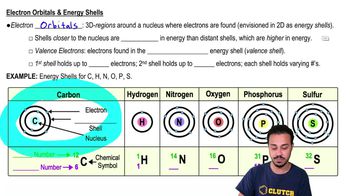
The Big Six elements are Oxygen (O), Carbon (C), Hydrogen (H), Nitrogen (N), Phosphorus (P), and Calcium (Ca), making up 99% of the matter in our bodies.
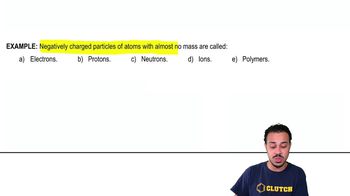
An atom is the smallest unit of matter retaining element properties, made of protons (+), neutrons (neutral), and electrons (-).
Atomic number is the number of protons; mass number is the sum of protons and neutrons in the nucleus.
Isotopes are atoms of the same element with the same number of protons but different numbers of neutrons.
Radioactive isotopes have unstable nuclei that decay spontaneously, releasing radiation used in medicine and research.
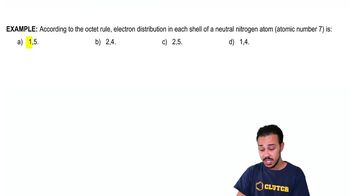
Electrons occupy shells around the nucleus; the outermost shell is the valence shell containing valence electrons involved in chemical bonding.
Inert atoms have complete outer electron shells and do not interact with other atoms.
Ionic bonds form when one atom transfers electrons to another, creating oppositely charged ions that attract each other.
Covalent bonds involve sharing of electrons between atoms to complete their valence shells.
Nonpolar covalent bonds share electrons equally; polar covalent bonds share electrons unequally, creating partial charges.
Hydrogen bonds are weak attractions between polar molecules involving hydrogen and electronegative atoms like oxygen or nitrogen.
A chemical reaction breaks existing bonds and forms new ones; reactants are starting materials, products are the results.
Cohesion is water molecules sticking together via hydrogen bonds; adhesion is water sticking to other substances.
Water absorbs and releases heat slowly due to hydrogen bonds, helping moderate temperature in organisms and environments.
Evaporative cooling occurs when the highest energy molecules evaporate, lowering the temperature of the remaining liquid.
Ice is less dense than liquid water because hydrogen bonds form a stable 3D crystal structure that spaces molecules apart.
Water is a universal solvent that dissolves ionic and polar compounds, forming aqueous solutions essential for life.
The pH scale measures acidity from 0 to 14; acids donate H+ ions, bases reduce H+ concentration.