Skip to main content
General Biology
My Course
Learn
Exam Prep
AI Tutor
Study Guides
Textbook Solutions
Flashcards
Explore
Try the app
My Course
Learn
Exam Prep
AI Tutor
Study Guides
Textbook Solutions
Flashcards
Explore
Try the app
Back
General Biology: Biomolecules and Macromolecules
You can tap to flip the card.
What are the four main classes of biological macromolecules?
You can tap to flip the card.
👆
What are the four main classes of biological macromolecules?
Nucleic acids
,
Proteins
,
Carbohydrates
, and
Lipids
.
Track progress
Control buttons has been changed to "navigation" mode.
1/21
Recommended videos
01:17
Introduction to Biomolecules
27829
views
568
rank
4
comments
01:29
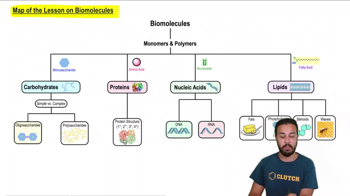
Map of the Lesson on Biomolecules
22769
views
730
rank
Terms in this set (21)
Hide definitions
What are the four main classes of biological macromolecules?
Nucleic acids
,
Proteins
,
Carbohydrates
, and
Lipids
.
What is a polymer and what are its building blocks?
A
polymer
is a large molecule made of repeating smaller units called
monomers
.
What process links monomers to form polymers?
Dehydration synthesis
(condensation) removes water to form a new bond between monomers.
How are polymers broken down into monomers?
Hydrolysis
adds water to break bonds, releasing monomers from polymers.
What are the monomers and polymers of carbohydrates?
Monomers:
Monosaccharides
; Polymers:
Polysaccharides
.
What are the monomers and polymers of proteins?
Monomers:
Amino acids
; Polymers:
Polypeptides
(proteins).
What are the monomers and polymers of nucleic acids?
Monomers:
Nucleotides
; Polymers:
DNA
and
RNA
.
Why is carbon essential in biological molecules?
Carbon can form
four covalent bonds
, allowing complex, diverse molecules with various shapes and functions.
What is the role of functional groups in biomolecules?
Functional groups are specific groups of atoms that
participate in chemical reactions
and determine molecule properties.
Name six common functional groups in biological molecules.
Hydroxyl, Carbonyl, Carboxyl, Amino, Sulfhydryl, Phosphate
.
What charge does the amino group carry at cellular pH?
The
amino group
is
basic
and typically forms a
positive charge
ion in aqueous cellular pH.
What charge does the carboxyl group carry at cellular pH?
The
carboxyl group
is
acidic
and typically forms a
negative charge
ion in aqueous cellular pH.
What is the molecular formula of glucose and a disaccharide made from two glucose molecules?
Glucose:
C6H12O6
; Disaccharide (e.g., maltose):
C12H22O11
after dehydration synthesis.
What type of bond links amino acids in proteins?
A
peptide bond
links amino acids via dehydration synthesis.
What determines the properties and folding of a protein?
The
side chains (R groups)
of amino acids determine protein folding and function.
What are the four levels of protein structure?
Primary
(amino acid sequence),
Secondary
(alpha helices and beta sheets),
Tertiary
(3D folding), and
Quaternary
(multi-subunit assembly).
How can changes in pH or temperature affect proteins?
They can cause
denaturation
, disrupting hydrogen and ionic bonds, leading to loss of structure and function.
What is the difference between DNA and RNA sugars?
DNA contains
deoxyribose
(lacking an -OH at 2' carbon), RNA contains
ribose
(with an -OH at 2' carbon).
What bases are found in DNA and RNA?
DNA:
A, T, C, G
; RNA:
A, U, C, G
(Uracil replaces Thymine).
What type of bonds hold complementary DNA bases together?
Hydrogen bonds
: A-T pairs have two bonds; G-C pairs have three bonds.
What is the directionality of nucleic acid strands?
Nucleic acids have a
5' to 3'
direction, with nucleotides linked by phosphodiester bonds between 5' phosphate and 3' hydroxyl groups.
 BackBack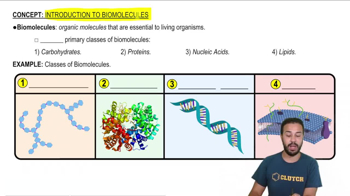
 01:17
01:17