Skip to main content
General Biology
My Course
Learn
Exam Prep
AI Tutor
Study Guides
Textbook Solutions
Flashcards
Explore
Try the app
My Course
Learn
Exam Prep
AI Tutor
Study Guides
Textbook Solutions
Flashcards
Explore
Try the app
Back
General Biology: Biomolecules and Macromolecules
You can tap to flip the card.
What are the four main classes of biological macromolecules?
You can tap to flip the card.
👆
What are the four main classes of biological macromolecules?
Nucleic acids
,
Proteins
,
Carbohydrates
, and
Lipids
.
Track progress
Control buttons has been changed to "navigation" mode.
1/20
Recommended videos
03:35
Carbon is an Excellent Building Block
21186
views
806
rank
04:19
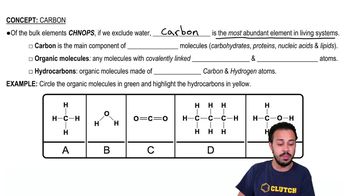
Carbon
28014
views
638
rank
2
comments
Terms in this set (20)
Hide definitions
What are the four main classes of biological macromolecules?
Nucleic acids
,
Proteins
,
Carbohydrates
, and
Lipids
.
What is a polymer and what are its building blocks?
A
polymer
is a large molecule made of repeating smaller units called
monomers
.
What process links monomers to form polymers?
Dehydration synthesis
(condensation) removes water to form a new bond between monomers.
How are polymers broken down into monomers?
Hydrolysis
adds water to break bonds, releasing monomers from polymers.
What is the chemical backbone of life and why?
Carbon
is the backbone because it can form four bonds, branch in four directions, and create diverse molecules.
What are functional groups in biological molecules?
Specific groups of atoms attached to carbon skeletons that determine chemical properties and reactions.
Name three important functional groups in biomolecules.
Hydroxyl (-OH)
,
Carboxyl (-COOH)
, and
Amino (-NH2)
groups.
What is the monomer and polymer of carbohydrates?
Monomer:
Monosaccharide
; Polymer:
Polysaccharide
.
What are the monomers and polymers of proteins?
Monomers:
Amino acids
; Polymers:
Polypeptides
or
Proteins
.
What is the monomer and polymer of nucleic acids?
Monomer:
Nucleotide
; Polymer:
DNA
or
RNA
.
What distinguishes DNA sugar from RNA sugar?
DNA contains
deoxyribose
(lacks 2' hydroxyl), RNA contains
ribose
(has 2' hydroxyl).
What bases are found in DNA and RNA?
DNA:
A, T, C, G
; RNA:
A, U, C, G
.
How do nucleotides link to form nucleic acids?
Via
phosphodiester bonds
between the 5' phosphate and 3' hydroxyl groups.
What is the directionality of nucleic acid strands?
Strands run
5' to 3'
with nucleotides added to the 3' end.
What is the role of enzymes in cells?
Enzymes are
proteins
that act as
catalysts
to speed up and regulate chemical reactions.
What determines the shape and function of a protein?
The
sequence of amino acids
and interactions of their
side chains
determine folding and function.
What are the four levels of protein structure?
Primary
(amino acid sequence),
Secondary
(alpha helices, beta sheets),
Tertiary
(3D folding),
Quaternary
(multi-subunit assembly).
How can pH and temperature affect proteins?
They can cause
denaturation
, disrupting bonds and altering protein shape and function.
What is the difference between hydrophilic and hydrophobic amino acid side chains?
Hydrophilic
side chains interact with water;
hydrophobic
side chains avoid water and tuck inside proteins.
What is ATP and its role in the cell?
Adenosine Triphosphate (ATP)
is the cell's main energy currency, providing energy for cellular processes.
 BackBack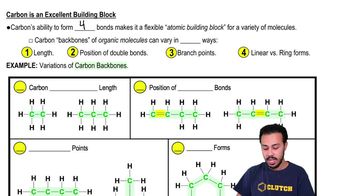
 03:35
03:35