 Back
BackGeneral Biology: Carbon and Functional Groups
 03:35
03:35
Terms in this set (20)
Isomers are molecules with the same molecular formula but different structures and properties.
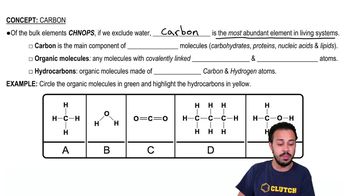
They make up 96% of living matter due to their ability to form diverse and stable bonds essential for life.
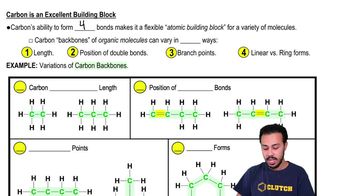
Carbon has 4 valence electrons and 4 valences, allowing it to form up to 4 covalent bonds with diverse atoms including itself.
A functional group is a specific group of atoms attached to a carbon skeleton that participates in chemical reactions and gives molecules unique properties.
Hydroxyl, Carbonyl, Carboxyl, Amino, Phosphate, Sulfhydryl, and Methyl groups.
They vary in length, branching, double or triple bonds, and ring structures, contributing to molecular diversity and complexity.
Aldehydes have a carbonyl group at the end of the carbon skeleton; ketones have it within the skeleton.
Carboxyl groups act as acids and amino groups act as bases, becoming ionized in cells.
The methyl group (-CH3) is nonpolar and does not improve solubility in water.
Isomers with different covalent arrangements of atoms.
Isomers with the same covalent bonds but differ in spatial arrangement around a double bond; cis groups on same side, trans on opposite sides.
Mirror-image isomers with four different groups attached to a carbon; often one is biologically active and the other inactive.
It increases solubility and is characteristic of alcohols.
A carbon double bonded to oxygen; aldehydes have it at the end, ketones within the carbon skeleton.
A carbon double bonded to oxygen and single bonded to hydroxyl; acts as an acid in cells.
A nitrogen bonded to two hydrogens; acts as a base under cellular conditions.
A phosphorus atom bonded to four oxygens; contributes negative charge and is part of DNA, membranes, and energy molecules.
A sulfur bonded to hydrogen; helps stabilize protein structure by forming covalent bonds.
A carbon bonded to three hydrogens; affects gene expression but does not improve solubility.
It changes the molecule's properties and function, e.g., male and female sex hormones differ only in functional groups.